TOC
- 1. What Is Rhyolite?
- 1-1. Rhyolite Quick Facts
- 1-2. Rhyolite vs. Granite: What’s the Difference?
- 2. What Is Rhyolite Made Of? How It Forms
- 3. The History and Meaning of Rhyolite
- 3-1. Rhyolite Spiritual Meaning
- 4. Rhyolite Colors, Types, and Trade Names
- 4-1. Rainforest Rhyolite (Rainforest Jasper)
- 4-2. Green Rhyolite
- 4-3. Birdseye Rhyolite, Wonderstone, and Other Varieties
- 5. Rhyolite Metaphysical and Healing Properties
- 5-1. Chakra, Zodiac, and How People Use It
- 6. Rhyolite and Gemstones: Vugs, Opal, and Red Beryl
- 7. Rhyolite Value: How Much Is It Worth?
- 8. How to Use and Care for Rhyolite
- 9. How to Tell Real Rhyolite
- 10. Frequently Asked Questions About Rhyolite
- 10-1. What is rhyolite?
- 10-2. Is rhyolite a rock or a crystal?
- 10-3. What is rainforest jasper?
- 10-4. What is green rhyolite?
- 10-5. How hard is rhyolite and can it get wet?
- 10-6. Is "Rhyolite" the ghost town the same as the rock?
- 11. Shop Rhyolite and Rainforest Jasper at KenKenGems

What Is Rhyolite?
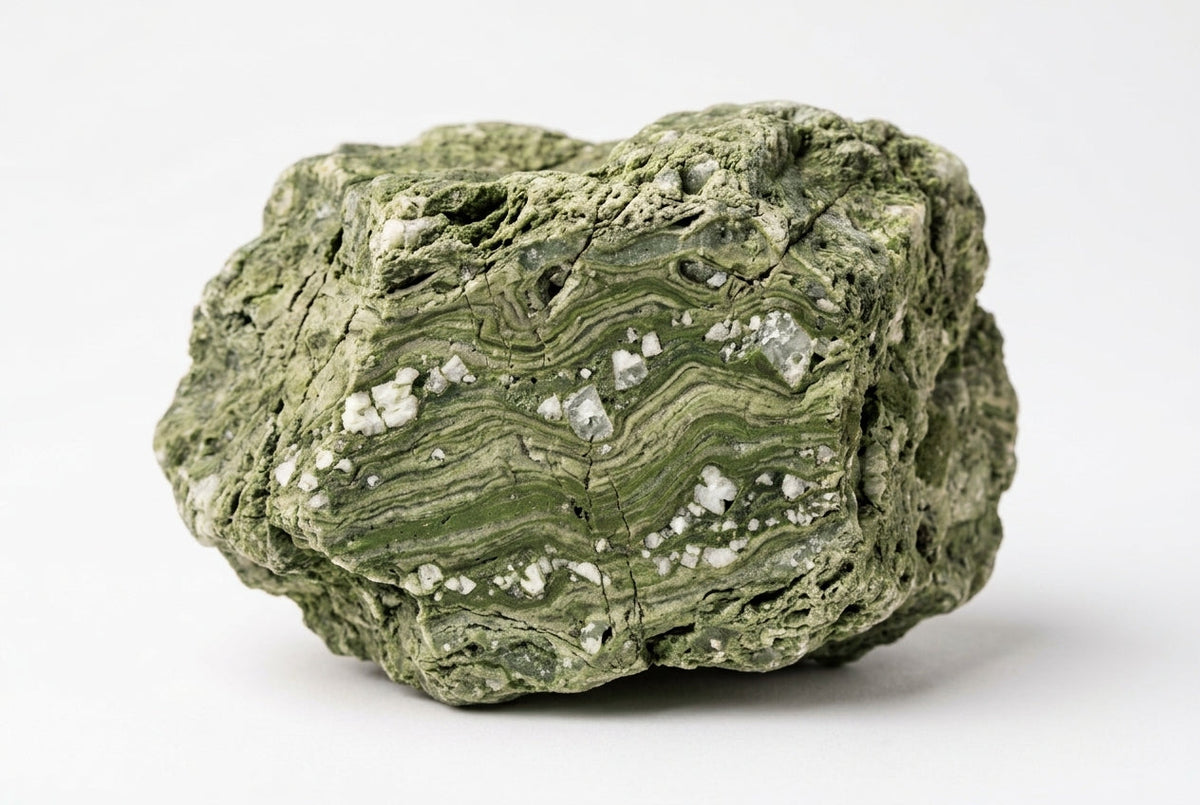
Rhyolite is a silica-rich volcanic (extrusive igneous) rock — the fine-grained, fast-cooled equivalent of granite. It is usually pale pink, gray, cream, or green, and is made mostly of quartz, alkali feldspar (sanidine), and plagioclase, often with tiny crystals of biotite or hornblende. Because the lava cools quickly at the surface, the grains are normally too small to see without a lens.
In everyday and lapidary use, "rhyolite" also refers to the patterned, polishable material cut for beads, cabochons, and tumbled stones — including popular trade varieties such as rainforest rhyolite (also sold as "rainforest jasper") and green rhyolite. So the same word covers both a common geological rock and a decorative gem material. Strictly speaking, rhyolite is a rock, not a single mineral species.

Rhyolite Quick Facts
| Property | Detail |
|---|---|
| Rock type | Extrusive igneous (volcanic) rock; felsic, silica-rich |
| Main minerals | Quartz, alkali feldspar (sanidine), sodic plagioclase |
| Accessory minerals | Biotite, hornblende, sometimes volcanic glass |
| Color | Pink, gray, cream, tan, red, and green (varies by minerals) |
| Hardness (Mohs) | About 6–7 (quartz-rich; durable for jewelry) |
| Texture | Fine-grained (aphanitic), glassy, or porphyritic |
| Intrusive equivalent | Granite |
| Popular varieties | Rainforest rhyolite (rainforest jasper), green rhyolite, birdseye rhyolite, wonderstone |
| Main sources | USA, Mexico, Australia, Brazil, Tanzania, and worldwide |
Rhyolite vs. Granite: What’s the Difference?
Rhyolite and granite share almost the same chemistry, but they cool in different places. Granite cools slowly deep underground, so it grows large, visible crystals. Rhyolite is the same magma erupted at the surface, where it cools fast and stays fine-grained or glassy. A quick rule of thumb: if you can easily see the interlocking crystals, it is probably granite; if the rock is smooth and fine with only occasional larger crystals (phenocrysts), it is likely rhyolite.
What Is Rhyolite Made Of? How It Forms
Rhyolite forms from granitic magma that is rich in silica (often more than 69% SiO2). High silica makes the magma extremely viscous (thick and slow-moving), which traps gas and favors explosive eruptions. For that reason rhyolite is often found as pyroclastic material — ash-flow tuff and pumice — as well as lava domes, flows, and dikes.
Eruptions of rhyolitic lava are relatively rare. Only a handful have been recorded in modern times, including Novarupta in Alaska (1912, the largest eruption of the 20th century), St. Andrew Strait in Papua New Guinea, and Chaitén and Cordón Caulle in Chile. When rhyolitic magma cools too fast to crystallize, it forms obsidian (volcanic glass); frothy, gas-rich rhyolite forms pumice.
As rhyolite cools, trapped gas can leave cavities called vugs. Later, mineral-rich fluids may fill those vugs — which is why rhyolite hosts some famous gem deposits (see the gemstones section below).

The History and Meaning of Rhyolite
The name "rhyolite" was introduced in 1860 by the German geologist Ferdinand von Richthofen, from the Greek *rhýax* ("a stream of lava") plus the rock suffix "-lite." Long before it had a name, rhyolite was valued for its toughness: in North America it was quarried for at least 11,500 years to make spear points, arrowheads, scrapers, and other tools, and it was traded widely because it held a sharp edge.
In modern crystal tradition, rhyolite is often called a stone of resolution, steady progress, and connection to nature — ideas inspired by its fiery volcanic origin and its earthy, flowing patterns. These are cultural and folkloric associations rather than scientifically proven effects.
Rhyolite Spiritual Meaning
Spiritually, rhyolite is traditionally associated with grounding, perseverance, and "living in the present." In crystal lore it is described as a stone that encourages people to work steadily toward goals and to feel more connected to the natural world. Green and rainforest varieties are especially linked in folklore with growth, renewal, and calm.
These are traditional beliefs, not medical claims. Crystals and rocks are not a substitute for professional medical or mental-health care.
Rhyolite Colors, Types, and Trade Names
Because its color depends on which minerals are present, rhyolite comes in many looks and trade names. The most searched-for varieties are below. Where a name uses "jasper," note that it is a trade name: the material is technically rhyolite, not true jasper.
Rainforest Rhyolite (Rainforest Jasper)
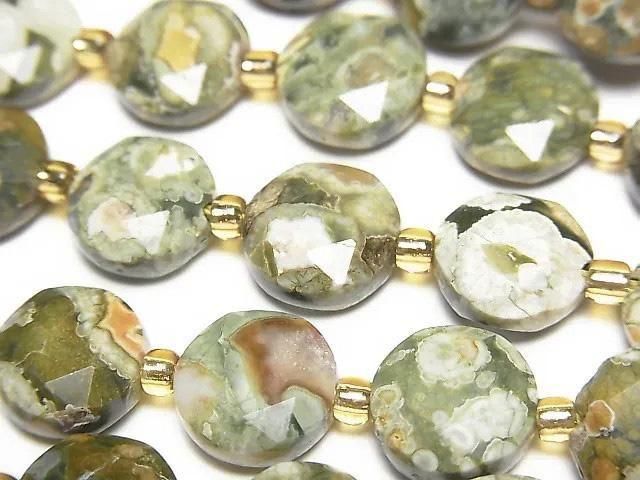
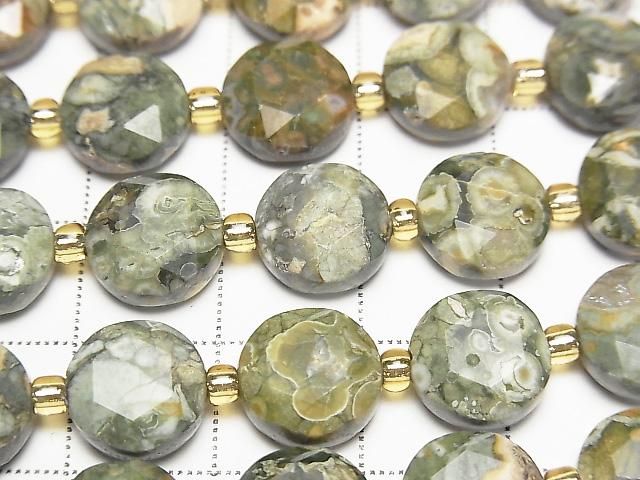
Rainforest rhyolite — widely sold as "rainforest jasper" — is a green-and-brown spherulitic rhyolite, most famously from Mount Hay in Queensland, Australia. It shows moss-like, orb-like, and landscape patterns in green, cream, red, and brown, created as gas cavities in the lava were later filled by agate, quartz, or other minerals.
Despite the popular name, this material is rhyolite, not true jasper (true jasper is a form of chalcedony). "Rainforest jasper" is a trade name used for its forest-like coloring. In crystal lore it is traditionally associated with nature, renewal, and a sense of ease.
Green Rhyolite
Green rhyolite ranges from soft sage to deep forest green, usually colored by green minerals formed during or after the lava cooled. Much rainforest rhyolite is green rhyolite. As with any colorful stone, some beads marketed as vividly green can be dyed; reputable sellers disclose any dye or treatment, so ask when the color looks unusually uniform.
Birdseye Rhyolite, Wonderstone, and Other Varieties
- Birdseye rhyolite — spherulitic rhyolite with small "eye" spots, often from Mexico, in brown, cream, red, pink, and gray.
- Wonderstone — a banded rhyolite from Nevada, USA, colored by iron oxide in cream, gray, maroon, and yellow-brown.
- Hickoryite / rainbow rhyolite — a finely banded Mexican rhyolite with colorful layers.
- Apache sage — a reddish, pink, or cream rhyolite from New Mexico with landscape-like dendrites.
- Flame / pink rhyolite — pale pink to tan rhyolite showing flow patterns.
Rhyolite Metaphysical and Healing Properties
In crystal-healing tradition, rhyolite is regarded as a grounding, motivating stone linked to self-discovery, creativity, and steady progress. Practitioners describe it as a gentle "stone of resolution" said to help people move forward and stay rooted in the present. Rainforest and green varieties are traditionally tied to nature, renewal, and calm.
Important: these descriptions reflect folklore and personal practice, not scientific or medical fact. Rhyolite cannot diagnose, treat, cure, or prevent any illness, and it is not a substitute for professional care. These are traditional beliefs, not medical claims.
Chakra, Zodiac, and How People Use It
In tradition, rhyolite is most often linked to the root and heart chakras and to the zodiac signs Sagittarius, Gemini, and Aquarius, with the element of earth (and fire, for its volcanic origin). People commonly wear it as beads or a pendant, keep a tumbled stone as a pocket piece, or hold it during meditation as a focus for intention — simple practices many enjoy regardless of belief.

Rhyolite and Gemstones: Vugs, Opal, and Red Beryl
One reason collectors prize rhyolite is that it hosts other gems. As thick, gas-rich lava cools quickly, trapped gas forms cavities (vugs). When later fluids or groundwater move through, minerals can crystallize inside — so some of the world’s finest deposits of fire opal, red beryl (bixbite), topaz, agate, and jasper are found in rhyolite.
Mexico is famous for fire opal in rhyolite, and the Wah Wah Mountains of Utah produce red beryl in a rhyolite matrix. Because cutting pure red beryl would waste most of the rough, it is often left in the rhyolite and sold as an attractive matrix specimen — a nice example of rhyolite’s dual role as both host rock and collectible.
Rhyolite Value: How Much Is It Worth?
Rhyolite is an abundant and affordable material, which is part of its appeal for jewelry makers and collectors. As a rough guide in the US and Canada (prices in USD and not guaranteed, since quality varies): tumbled stones typically run a few dollars each, bead strands often fall around $5–$30 depending on size and pattern, and cabochons of well-patterned rainforest rhyolite command more. Rare gem-in-rhyolite specimens — fire opal or red beryl in matrix — can be priced far higher for their included gems.
Value comes down to pattern, color, and finish: crisp spherulites or "scenes," balanced green-and-brown coloring, clean polish, and intact (uncracked) material raise a piece’s worth. Because rhyolite is graded on individual appearance rather than a fixed scale, the best approach is to choose the piece whose pattern you love at a price that fits your budget.
How to Use and Care for Rhyolite
At about 6–7 on the Mohs scale, rhyolite is durable enough for everyday jewelry such as bracelets, pendants, and earrings, and it is a favorite for mala-style and stacking beads. Raw and vuggy pieces can be more brittle, so handle rough specimens gently.
Care is simple: clean with mild soap and lukewarm water, dry with a soft cloth, and avoid harsh chemicals, ultrasonic cleaners, and prolonged direct sunlight (especially for any dyed material, which can fade). Store harder gems separately so they don’t scratch the polish.
How to Tell Real Rhyolite
Genuine rhyolite shows natural, slightly irregular flow bands, spherulites, or "landscape" patterns, with a cool, fairly dense feel and a quartz-hard surface (about 6–7 Mohs) that will not scratch with a steel blade. Warning signs of imitation include perfectly repeating patterns (molded resin), color concentrated in surface cracks (dye), and a light, warm, plasticky feel.
When buying "rainforest jasper" or "green rhyolite," remember the material is rhyolite rather than true jasper, and ask whether any color has been dyed or enhanced. Reputable sellers state locality and any treatment as standard.

Frequently Asked Questions About Rhyolite
What is rhyolite?
Rhyolite is a silica-rich volcanic (extrusive igneous) rock — the fine-grained equivalent of granite — made mostly of quartz and feldspar. It is also cut as a decorative gem material, including rainforest rhyolite and green rhyolite.
Is rhyolite a rock or a crystal?
It is a rock, not a single mineral or crystal. Rhyolite is made of many tiny mineral grains (mainly quartz and feldspar). It is sold alongside crystals and gemstones, but geologically it is a volcanic rock.
What is rainforest jasper?
Rainforest jasper is a trade name for rainforest rhyolite, a green-and-brown spherulitic rhyolite famous from Mount Hay, Australia. Despite the name, it is rhyolite, not true jasper.
What is green rhyolite?
Green rhyolite is rhyolite colored green by green minerals; much rainforest rhyolite is green rhyolite. Some vividly green beads may be dyed, so ask the seller to confirm natural color.
How hard is rhyolite and can it get wet?
Rhyolite is about 6–7 on the Mohs scale and is fine for everyday wear. A quick rinse is okay; avoid long soaks, harsh chemicals, and prolonged sunlight, especially for dyed pieces.
Is "Rhyolite" the ghost town the same as the rock?
No. Rhyolite, Nevada is a historic ghost town named after the local rock. This guide is about the rock and gemstone material, not the town.
Shop Rhyolite and Rainforest Jasper at KenKenGems
Ready to add rhyolite to your designs or collection? KenKenGems supplies rhyolite and rainforest rhyolite (rainforest jasper) as bead strands, tumbled stones, and cabochons, chosen for clear patterns and clean polish. Prices are listed in USD, with shipping across the United States and Canada. Browse the collection to find the green-and-earth pattern that speaks to you.