
TOC
- 1. What Is an Ammonite? Definition and Quick Answer
- 1-1. Ammonite Quick Facts
- 1-2. Ammonite vs. Nautilus: What's the Difference?
- 2. Inside an Ammonite Shell: Chambers, Sutures, and the Spiral
- 3. When Did Ammonites Live — and Why Did They Disappear?
- 4. The History and Folklore of Ammonites
- 5. Ammonite Meaning and Symbolism
- 5-1. Ammonite Spiritual Meaning
- 6. Ammonite Metaphysical Properties
- 7. Ammolite: The Gemstone Made from Ammonite Shells
- 8. Types of Ammonite Fossils
- 9. Where Are Ammonites Found?
- 10. How to Use and Display Ammonite
- 11. How to Care for Ammonite Fossils and Ammolite
- 12. How to Tell If an Ammonite Is Real
- 13. Ammonite Value: How Much Is It Worth?
- 14. Frequently Asked Questions About Ammonites
- 14-1. What is an ammonite, in simple terms?
- 14-2. Are ammonites dinosaurs?
- 14-3. Is an ammonite a crystal or a fossil?
- 14-4. What is the difference between ammonite and ammolite?
- 14-5. What does the ammonite spiral symbolize?
- 14-6. Can ammonites go in water?
- 15. Shop Ammonite Fossils and Ammolite at KenKenGems

What Is an Ammonite? Definition and Quick Answer
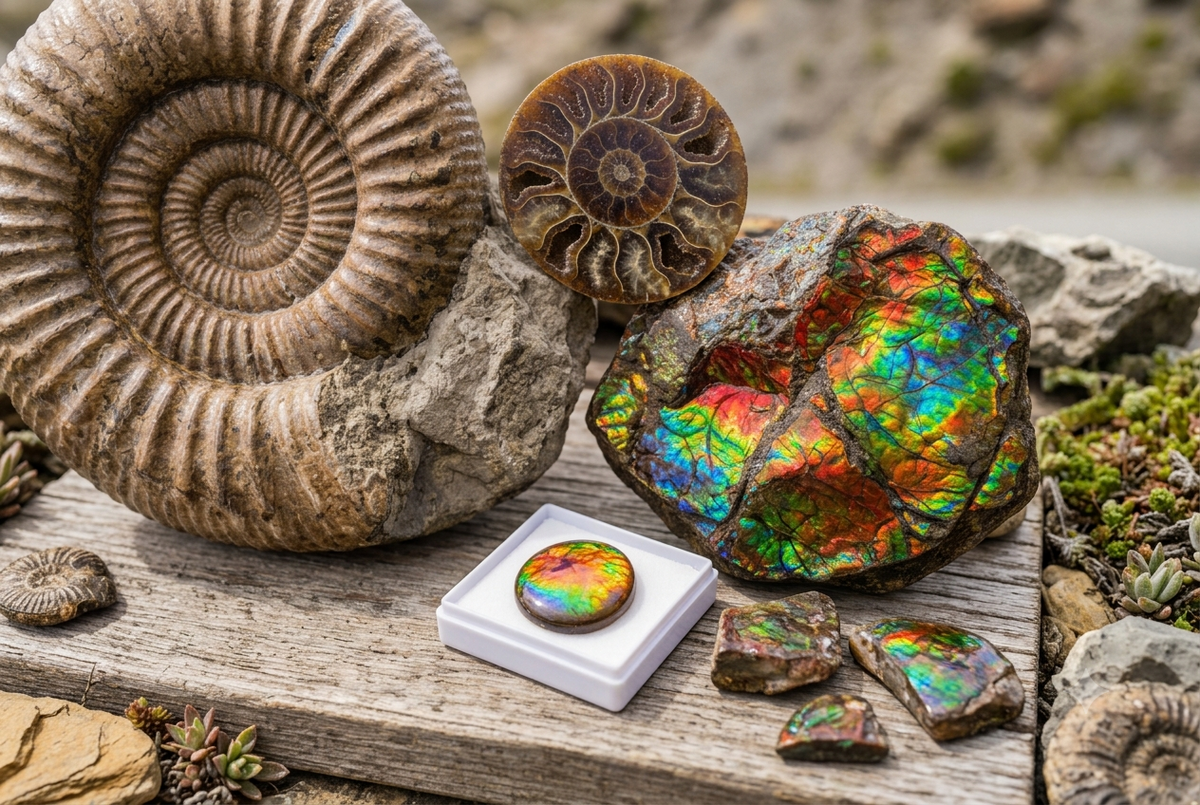
By definition, an ammonite is an extinct marine mollusk of the subclass Ammonoidea — a cephalopod, the same broad animal group that includes today's squid, octopus, cuttlefish, and nautilus. Ammonites lived inside a coiled, chambered shell, and it is that shell, preserved in rock, that we find as a fossil.
In everyday use, “ammonite” refers to the fossil itself. Because the shells often preserve beautifully — sometimes replaced by calcite, pyrite, or iridescent aragonite — they're sold and displayed much like gemstones, which is why you'll also hear them called ammonite stones or ammonite crystals. Strictly speaking, though, an ammonite is a fossil, not a mineral species.

Ammonite Quick Facts
| Attribute | Details |
|---|---|
| What it is | Fossilized shell of an extinct marine cephalopod (subclass Ammonoidea) |
| Lived | Roughly 400 to 66 million years ago (Devonian to end-Cretaceous) |
| Extinction | Died out in the K–Pg mass extinction, the same event that ended the non-avian dinosaurs |
| Closest living relatives | Squid, octopus, and cuttlefish (more so than the nautilus) |
| Shell | Coiled and chambered; grew in a logarithmic spiral |
| Typical size | About 1–30 cm; the largest known specimens approach 1.8 m across |
| Name origin | The ram-horned deity Ammon (Amun); Pliny the Elder recorded them as ammonis cornua |
| Main fossil sources | Morocco, Madagascar, England, Germany, Canada, USA |
| Gem form | Ammolite — iridescent gem material from fossilized shell, mainly from Alberta, Canada |
Ammonite vs. Nautilus: What's the Difference?
They look similar, but they're not close relatives. The nautilus is a living cephalopod whose lineage survived to the present day; ammonites are entirely extinct. Beyond that:
- Relationship — despite the resemblance, ammonites are thought to be more closely related to squid, octopus, and cuttlefish than to the nautilus
- Suture lines — where the internal walls meet the shell, ammonites show intricate, frilled, fern-like patterns, while nautiloids show simple, gently curved lines. This is the classic way specialists tell them apart
- Siphuncle position — in ammonites the tube connecting the chambers usually runs along the outer edge of the shell; in nautiluses it runs through the center
If you're looking at a fossil with elaborate, wavy suture patterns on its surface, you're almost certainly looking at an ammonite.
Inside an Ammonite Shell: Chambers, Sutures, and the Spiral
An ammonite shell is not a solid coil — it's a series of gas- and liquid-filled chambers (camerae) separated by thin walls called septa, with a slender tube called the siphuncle running through them. The animal itself lived only in the final, largest chamber; by adjusting the fluid in the older chambers, it controlled its buoyancy much as a submarine does.
As the animal grew, it built new chambers at the shell's opening, expanding at a steady proportional rate. The result is a logarithmic spiral — the same growth pattern seen in sunflower heads and galaxies. (You'll often see this called a “Fibonacci” or “golden” spiral; strictly speaking it's a logarithmic spiral, and the proportions vary between species.)
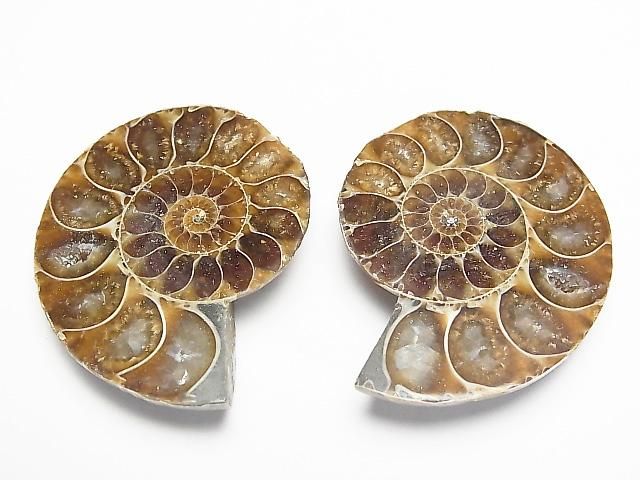
When a shell fossilizes and is cut or polished, those chambers are revealed — sometimes lined with sparkling calcite or filled with pyrite, which is why sliced ammonites are so prized as display pieces.


When Did Ammonites Live — and Why Did They Disappear?
Ammonites first appear in the fossil record in the Devonian period, roughly 400 million years ago, and they thrived through the Mesozoic era — the age of the dinosaurs — evolving into thousands of species. They vanished about 66 million years ago in the Cretaceous–Paleogene (K–Pg) mass extinction, the same event that wiped out the non-avian dinosaurs.
Because ammonite species evolved quickly, spread widely, and are easy to distinguish, geologists use them as index fossils: finding a particular species in a rock layer helps date that layer with real precision. In other words, these shells aren't just beautiful — they're one of the tools that let us read the timeline of Earth's history.
The History and Folklore of Ammonites
The name comes from the ancient deity Ammon (Amun), often depicted with ram's horns — the coiled shells reminded observers of those horns. The Roman naturalist Pliny the Elder recorded them as ammonis cornua, the horns of Ammon, and the name stuck.
In medieval England, ammonites were believed to be coiled snakes turned to stone. Around Whitby in Yorkshire, the legend credited Saint Hilda with clearing the land of serpents by petrifying them; local carvers sometimes added snake heads to the fossils to complete the story, and “snakestones” appear in the town's heraldry to this day.
In Nepal and India, ammonite fossils from the Gandaki River are revered as shaligram — sacred stones regarded in Hindu tradition as manifestations of Vishnu, kept in temples and home shrines. Few fossils carry as much cultural weight across so many cultures.
Ammonite Meaning and Symbolism
The core ammonite meaning is change — specifically, growth that unfolds over time. The spiral records the animal's entire life, chamber by chamber, expanding outward from a tiny center. It's a natural diagram of a life story, which is why the ammonite has become a symbol of evolution, continuity, and the long view.
In modern crystal and symbolic practice, the ammonite represents:
- Change and forward movement through life's phases
- The passage of time and connection to ancient history
- Growth that builds on what came before
- Cycles, journeys, and life paths
- Grounded perspective — a reminder that difficulties pass
Because of this symbolism, ammonites are popular gifts for graduations, career changes, milestone birthdays, and anyone navigating a new chapter.
Ammonite Spiritual Meaning
Spiritually, the ammonite is regarded as a stone of transformation and deep time. Practitioners describe the spiral as a path inward and outward at once — used in meditation to reflect on where you've come from and where you're heading. Because ammonites are the remains of creatures that lived hundreds of millions of years ago, many people also work with them to feel connected to ancestry, deep history, and the scale of natural time. Some traditions place ammonites at the third eye or root chakra during meditation for grounding and insight.

Ammonite Metaphysical Properties
In crystal and symbolic practice, ammonites are valued as grounding, perspective-giving objects rather than high-energy stones. Practitioners commonly associate them with:
- Releasing what no longer serves you — the spiral is described as drawing in stagnant energy and returning it renewed
- Support during transitions and life changes
- A sense of stability and connection to the earth's history
- Focus in meditation, using the spiral as a visual anchor
- In feng shui, prosperity and steady, flowing energy in a room
Important note: these associations reflect metaphysical traditions and personal practice, not scientific or medical fact. Ammonites are fossils, and no crystal or fossil is a substitute for professional medical or mental-health care. Enjoy them as meaningful objects, not as treatment.
Ammolite: The Gemstone Made from Ammonite Shells
The most valuable form of ammonite isn't a fossil specimen at all — it's a gemstone. Ammolite is the rare, iridescent gem material cut from the fossilized aragonite shell of certain ammonites, flashing red, green, gold, and occasionally blue and violet as it moves in the light.
What makes ammolite notable:
- Source — commercially viable material comes almost entirely from a small area of southern Alberta, Canada (the Bearpaw Formation), making it one of the world's most geographically limited gems
- Recognition — ammolite was recognized as a gemstone by the World Jewellery Confederation (CIBJO) in 1981, and it is Alberta's official gemstone
- Organic origin — like amber and pearl, ammolite is a biogenic (organic) gem rather than a mineral crystal
- Construction — the gem layer is extremely thin and fragile, so ammolite is usually sold as a doublet or triplet, backed and capped for durability
- Hardness — soft, roughly 3.5–4.5 on the Mohs scale, so it needs protective settings and gentle care
In feng shui circles ammolite is sometimes called the “seven color prosperity stone,” a modern association rather than a historical one.


Types of Ammonite Fossils
Not all ammonites look alike — how a shell fossilized determines its appearance and value:
- Calcified / natural shell — the most common; brown to gray shells, often polished to reveal suture patterns
- Pyritized — the shell replaced by golden pyrite, giving a striking metallic finish (Russia and England produce fine examples)
- Ammolite — iridescent gem-grade shell material, primarily from Alberta, Canada
- Opalized — shell replaced by opal-like material, producing a play of color
- Cut and polished halves — sliced to expose the internal chambers, sometimes lined with sparkling calcite crystals
- Goniatites — an older, related ammonoid group with simpler suture patterns, common from Morocco and often sold alongside ammonites
Size also varies enormously, from thumbnail specimens to plates over a meter across.
Where Are Ammonites Found?
Ammonite fossils occur on every continent, but a handful of localities supply most of what you'll see for sale:
- Morocco — the Atlas Mountains and the Erfoud region are the world's largest commercial source, supplying most polished specimens and goniatites
- Madagascar — known for large, richly patterned polished ammonites and sliced pairs
- England — the Jurassic Coast (Lyme Regis, Charmouth) and Whitby in Yorkshire, both historic and legally protected collecting areas
- Germany — Holzmaden and the surrounding Jurassic shales, famous for exceptionally preserved specimens
- Canada — southern Alberta, the source of gem-quality ammolite
- United States — South Dakota and other western states
If you collect in the field, always check local rules: many classic sites are protected, and some require permits.
How to Use and Display Ammonite
Ammonites are enjoyed less as pocket stones and more as objects you live with:
- Display — a polished specimen or matched pair of halves makes a natural sculpture for a shelf, desk, or entryway; bookends and stands are popular
- Jewelry — smaller whole ammonites and ammolite pieces are set as pendants and rings; because the material is soft, protective bezel settings are the smart choice
- Meditation and focus — hold a small specimen or trace the spiral with your eye as a visual anchor while breathing slowly
- Gifts — the spiral's symbolism of growth and change suits graduations, new jobs, retirements, and milestone birthdays
- Learning — for families, an ammonite is an approachable, hands-on way to introduce children to fossils and deep time
For jewelry makers, ammonite and ammolite pair beautifully with silver and with warm stones like citrine and carnelian.
How to Care for Ammonite Fossils and Ammolite
Ammonite fossils are calcium carbonate, so they're softer and more chemically sensitive than quartz-based gems:
- Dust with a soft, dry brush or cloth; if needed, wipe briefly with a barely damp cloth and dry at once
- Avoid soaking, acids, vinegar, and household cleaners — calcium carbonate reacts with acid and can be etched permanently
- Skip ultrasonic and steam cleaners entirely
- Keep specimens out of prolonged direct sunlight and away from heat sources and sharp humidity swings, which can cause fine cracking
- Store or display where they won't be knocked; polished edges chip easily
Ammolite needs extra care: it's soft (about 3.5–4.5 on the Mohs scale), usually a thin layer in a doublet or triplet, and vulnerable to water seeping between layers. Remove ammolite jewelry before washing hands, swimming, or applying cosmetics, and clean it with nothing more than a dry or barely damp soft cloth.

How to Tell If an Ammonite Is Real
Genuine ammonites are common enough that outright fakes are less of a problem than with rare fossils — but resin replicas, heavily restored pieces, and enhanced colors do circulate. What to check:
- Suture lines — real ammonites show intricate, naturally irregular suture patterns; cast replicas often have soft, repetitive, or blurred detail
- Weight and temperature — stone feels dense and cool; resin is noticeably light and warms quickly in the hand
- Matrix and imperfections — genuine specimens usually show natural rock matrix, small chips, or asymmetry; flawless, perfectly identical pieces are a warning sign
- Repeated patterns — if several “specimens” share identical detail, they were cast from one mold
- Restoration and paint — some commercial specimens are legitimately repaired or stabilized; ask what has been done. Vivid, uniform coloring can indicate dye rather than natural mineralization
- For ammolite — ask whether the piece is a solid, doublet, or triplet, and whether it has been stabilized; reputable sellers disclose this as standard
Buying from suppliers who state locality and any treatment is the simplest safeguard.
Ammonite Value: How Much Is It Worth?
Ammonites span an enormous price range, from pocket-money fossils to museum pieces. Typical US ranges:
- Small whole specimens and goniatites (2–5 cm): about $5–$25
- Polished halves and matched pairs (5–15 cm): roughly $20–$150
- Large polished specimens and display plates: from a few hundred dollars upward
- Pyritized and finely preserved specimens: priced well above common material for their finish and rarity
- Ammolite jewelry: from around $50 for small accent pieces to several hundred or more for large, high-grade doublets and triplets with strong red and violet flash
Value is driven by size, completeness, how clearly the sutures or chambers show, quality of preparation and polish, locality, and — for ammolite — the brightness, color range, and coverage of the iridescence. Red and violet flashes are rarer than green and gold, and priced accordingly.

Frequently Asked Questions About Ammonites
What is an ammonite, in simple terms?
An ammonite is the fossilized spiral shell of an extinct sea creature — a cephalopod related to today's squid and octopus. They lived from roughly 400 million years ago until about 66 million years ago.
Are ammonites dinosaurs?
No. Ammonites were marine mollusks, not reptiles. They did, however, die out in the same mass extinction event that ended the non-avian dinosaurs about 66 million years ago.
Is an ammonite a crystal or a fossil?
It's a fossil. Ammonites are sold alongside crystals and are sometimes called “ammonite stones,” but they're the preserved shells of once-living animals, not mineral species — though the shell can be replaced by minerals such as calcite, pyrite, or aragonite.
What is the difference between ammonite and ammolite?
Ammonite is the fossil; ammolite is the rare iridescent gem material cut from certain fossilized ammonite shells, found mainly in southern Alberta, Canada.
What does the ammonite spiral symbolize?
It's widely taken as a symbol of change, growth, and the passage of time — the shell records the animal's entire life, chamber by chamber, expanding outward from a tiny beginning.
Can ammonites go in water?
Best not to. Ammonite shells are calcium carbonate and can be damaged by long soaking and by anything acidic. Clean them with a dry or barely damp cloth, and keep ammolite jewelry away from water entirely.
Shop Ammonite Fossils and Ammolite at KenKenGems
Ready to bring a piece of deep time into your home or your designs? KenKenGems is a Japan-based gemstone supplier trusted by makers and collectors worldwide, and every ammonite we offer is selected for clear detail and clean preparation. You'll find:
- Whole and polished ammonite specimens, including matched halves
- Ammolite pieces for pendants, rings, and statement jewelry
- Fossil cabochons and loose pieces for custom designs
We describe locality and any stabilization or doublet/triplet construction so you know exactly what you're buying. Prices are listed in USD, and we ship to the United States and Canada.


![[One of a kind] Ammonite Plate 1pc No.206](http://store.kenkengems.com/cdn/shop/files/188243171.jpg?v=1758614728&width=640)
![[One of a kind] Ammonite Plate 1pc No.206](http://store.kenkengems.com/cdn/shop/files/188243171_o1.jpg?v=1758614723&width=640)
![[One of a kind] High Quality Ammolite AAA- Pendant Silver925 No.25](http://store.kenkengems.com/cdn/shop/files/188483867.jpg?v=1758617064&width=640)
![[One of a kind] High Quality Ammolite AAA- Pendant Silver925 No.25](http://store.kenkengems.com/cdn/shop/files/188483867_o1.jpg?v=1758617070&width=640)
![[One of a kind] Ammonite Plate 1pc No.9](http://store.kenkengems.com/cdn/shop/files/188242054.jpg?v=1758614644&width=640)
![[One of a kind] Ammonite Plate 1pc No.9](http://store.kenkengems.com/cdn/shop/files/188242054_o1.jpg?v=1758614639&width=640)
![[One of a kind] Ammonite Pyrite Pendant Silver925 No.147](http://store.kenkengems.com/cdn/shop/files/185691219.jpg?v=1744875763&width=640)
![[One of a kind] Ammonite Pyrite Pendant Silver925 No.147](http://store.kenkengems.com/cdn/shop/files/185691219_o1.jpg?v=1744875769&width=640)
![[One of a kind] Madagascar Ammonite 2pcs (pair) No.9](http://store.kenkengems.com/cdn/shop/files/184758835.jpg?v=1742280115&width=640)
![[One of a kind] Madagascar Ammonite 2pcs (pair) No.9](http://store.kenkengems.com/cdn/shop/files/184758835_o1.jpg?v=1742280120&width=640)
![[One of a kind] Madagascar Ammonite 2pcs (pair) No.10](http://store.kenkengems.com/cdn/shop/files/184758836.jpg?v=1742280127&width=640)
![[One of a kind] Madagascar Ammonite 2pcs (pair) No.10](http://store.kenkengems.com/cdn/shop/files/184758836_o1.jpg?v=1742280133&width=640)
![[One of a kind] Ammonite Plate 1pc No.212](http://store.kenkengems.com/cdn/shop/files/188243179.jpg?v=1758614699&width=640)
![[One of a kind] Ammonite Plate 1pc No.212](http://store.kenkengems.com/cdn/shop/files/188243179_o1.jpg?v=1758614693&width=640)
![[One of a kind] Ammonite Pyrite Pendant 18KGP No.142](http://store.kenkengems.com/cdn/shop/files/185691214.jpg?v=1744875702&width=640)
![[One of a kind] Ammonite Pyrite Pendant 18KGP No.142](http://store.kenkengems.com/cdn/shop/files/185691214_o1.jpg?v=1744875709&width=640)

![[One of a kind] Ammonite Plate 1pc No.7](http://store.kenkengems.com/cdn/shop/files/188242052.jpg?v=1758614621&width=640)
![[One of a kind] Ammonite Plate 1pc No.7](http://store.kenkengems.com/cdn/shop/files/188242052_o1.jpg?v=1758614615&width=640)
![[One of a kind] Ammonite Plate 1pc No.5](http://store.kenkengems.com/cdn/shop/files/188242050.jpg?v=1758614590&width=640)
![[One of a kind] Ammonite Plate 1pc No.5](http://store.kenkengems.com/cdn/shop/files/188242050_o1.jpg?v=1758614596&width=640)
![[One of a kind] High Quality Ammolite AAA- Pendant Silver925 No.10](http://store.kenkengems.com/cdn/shop/files/188483850.jpg?v=1758616618&width=640)
![[One of a kind] High Quality Ammolite AAA- Pendant Silver925 No.10](http://store.kenkengems.com/cdn/shop/files/188483850_o1.jpg?v=1758616624&width=640)


