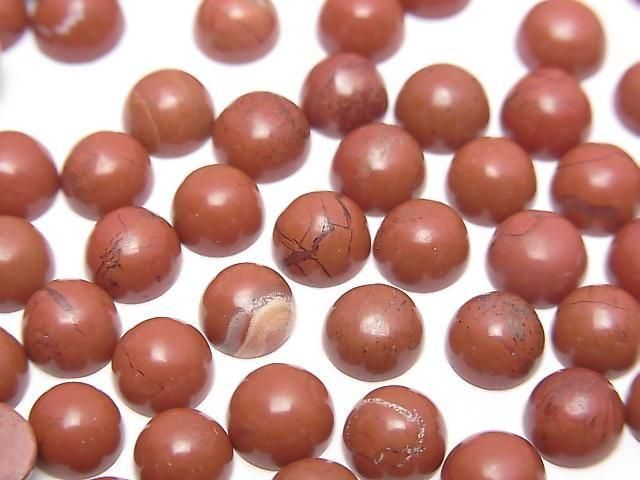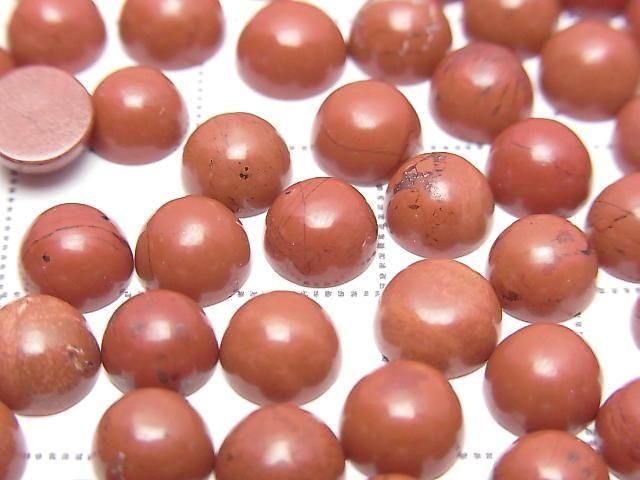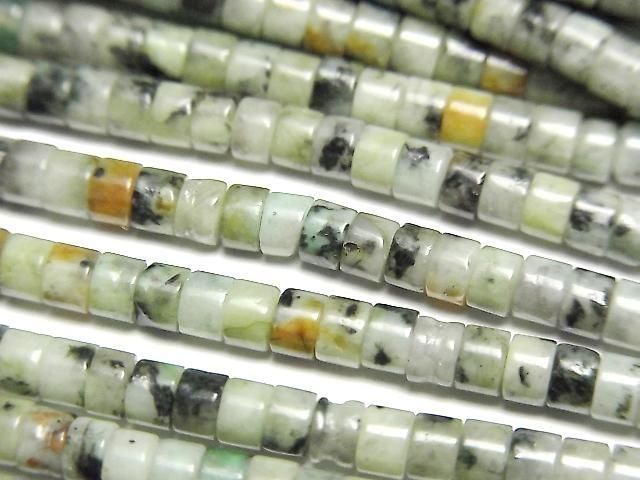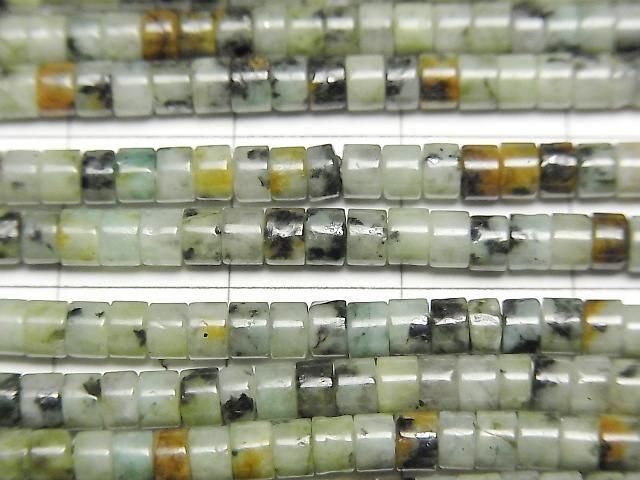
TOC
- 1. What Is Kambaba Jasper?
- 1-1. Is Kambaba Jasper a Fossil (Stromatolite) or a Volcanic Rock?
- 2. Kambaba Jasper Properties: Physical and Chemical
- 2-1. What Does Kambaba Jasper Look Like?
- 3. Where Does Kambaba Jasper Come From?
- 4. Kambaba Jasper Meaning
- 4-1. Kambaba Jasper Metaphysical Properties
- 4-2. Kambaba Jasper and the Chakras
- 5. Kambaba Jasper Healing Properties: What Crystal Lore Says
- 5-1. How People Use Kambaba Jasper
- 6. Kambaba Jasper vs. Nebula Stone, Rhyolite, and Other Look-Alikes
- 7. Kambaba Jasper in Jewelry: Beads, Cabochons, and Durability
- 8. How to Tell If Kambaba Jasper Is Real
- 9. How to Clean and Care for Kambaba Jasper
- 10. Frequently Asked Questions About Kambaba Jasper
- 10-1. What is kambaba jasper good for?
- 10-2. What is the meaning of kambaba jasper?
- 10-3. Is kambaba jasper a real jasper?
- 10-4. Is kambaba jasper a fossil or a stromatolite?
- 10-5. Where is kambaba jasper from?
- 10-6. What is the difference between kambaba jasper and nebula stone?
- 10-7. How hard is kambaba jasper?
- 10-8. Can kambaba jasper get wet?
- 10-9. What chakra is kambaba jasper associated with?
- 10-10. Is kambaba jasper dyed?
- 11. Shop Kambaba Jasper and Other Jasper Beads at KenKenGems
- 12. Sources and Further Reading

Kambaba jasper is a dark green stone patterned with black and deep-green circular "eyes" and swirls, mined in Madagascar and sold as beads, cabochons, tumbled stones, and spheres. In crystal lore it is a stone of calm, grounding, and steady strength, traditionally linked to the heart and root chakras. Geologically it is not a true jasper at all: laboratory analysis of the commercial material shows a quartz-, feldspar-, and aegirine-bearing volcanic rock, which is why you will also see it sold as crocodile jasper, kambaba stone, or green stromatolite jasper.
This guide explains the meaning and metaphysical properties of kambaba jasper, what the stone actually is (and why the "3-billion-year-old fossil" story is disputed), where it comes from, how to tell it from nebula stone, rhyolite, and other look-alikes, how it performs in jewelry, and how to care for it.

What Is Kambaba Jasper?
Kambaba jasper is the trade name for an opaque, green-and-black orbicular stone from Madagascar. The name is not a mineralogical one: "jasper" is used loosely in the lapidary trade for almost any opaque, patterned, silica-rich stone that takes a good polish, and kambaba qualifies on looks rather than chemistry. You will find the same material under several names:
- Kambaba jasper, kambaba stone, kabamba, kambamba, cumbamba (spelling variants of the same trade name)
- Crocodile jasper or crocodile rock, after the scale-like pattern of dark orbs
- Green stromatolite jasper, from the widely repeated (and disputed) claim that it is a fossil
- Star galaxy jasper, a name used by some cutters in India
Whatever the label, the stone is the same: a fine-grained green groundmass with black or dark-green rounded orbs that range from pinhead size to an inch or more across. It is dense, opaque, takes a high polish, and is hard enough for everyday jewelry.

Is Kambaba Jasper a Fossil (Stromatolite) or a Volcanic Rock?
Both stories circulate, and the honest answer is that the material sold as kambaba jasper has been described in two different ways:
- The fossil story: many crystal retailers describe kambaba as a stromatolite, a layered structure built by cyanobacteria (blue-green algae) in shallow ancient seas, and call it "3 billion years old." Stromatolites are real and are among the oldest evidence of life on Earth, and some Madagascar material sold under similar names does appear to be sedimentary.
- The volcanic story: thin-section and X-ray diffraction analysis of commercial kambaba material, reported by the German gemstone testing institute EPI, found no sedimentary or fossil structure. Instead it identified a volcanic (rhyolite-like) rock: a groundmass of quartz and the green pyroxene aegirine, with orbs of alkali feldspar containing needle-like amphibole minerals. Geologists who have worked in Madagascar suggest that two different stones with similar local names have simply been mixed up in the trade.
For buyers, the practical takeaway is this: most kambaba jasper beads and cabochons on the market are best described as a green orbicular volcanic rock, not a fossil, and the "billions of years old" claim should be treated as marketing unless a seller can document it for a specific lot. KenKenGems describes the material by its appearance and origin rather than by an unverified fossil claim.

Kambaba Jasper Properties: Physical and Chemical
Kambaba jasper is a hard, dense, opaque rock, which is exactly why it is so widely cut into beads and cabochons. Because it is a rock (a mixture of minerals) rather than a single mineral, its properties are ranges rather than fixed values.
| Property | Value |
|---|---|
| Classification | Rock, not a mineral; orbicular volcanic rock (rhyolite-type) per laboratory analysis; traded as a "jasper" |
| Main minerals | Quartz, alkali feldspar (albite/orthoclase), aegirine (green pyroxene); amphibole needles (riebeckite–pargasite) in the orbs |
| Color | Medium to dark green groundmass with black or very dark green orbs and swirls |
| Pattern | Orbicular (rounded "eyes"), sometimes with streaks; no two cuts alike |
| Hardness (Mohs) | About 6 – 7 (quartz-rich; softer feldspar and aegirine zones are around 6) |
| Specific gravity | Roughly 2.6 – 2.9 |
| Luster | Vitreous to waxy when polished |
| Transparency | Opaque |
| Fracture | Conchoidal to uneven |
| Treatments | None usual; cut and polished only. Some beads may be waxed or oiled for luster |
| Source | Madagascar (Bongolava region, west-central Madagascar, is the documented locality) |
What Does Kambaba Jasper Look Like?
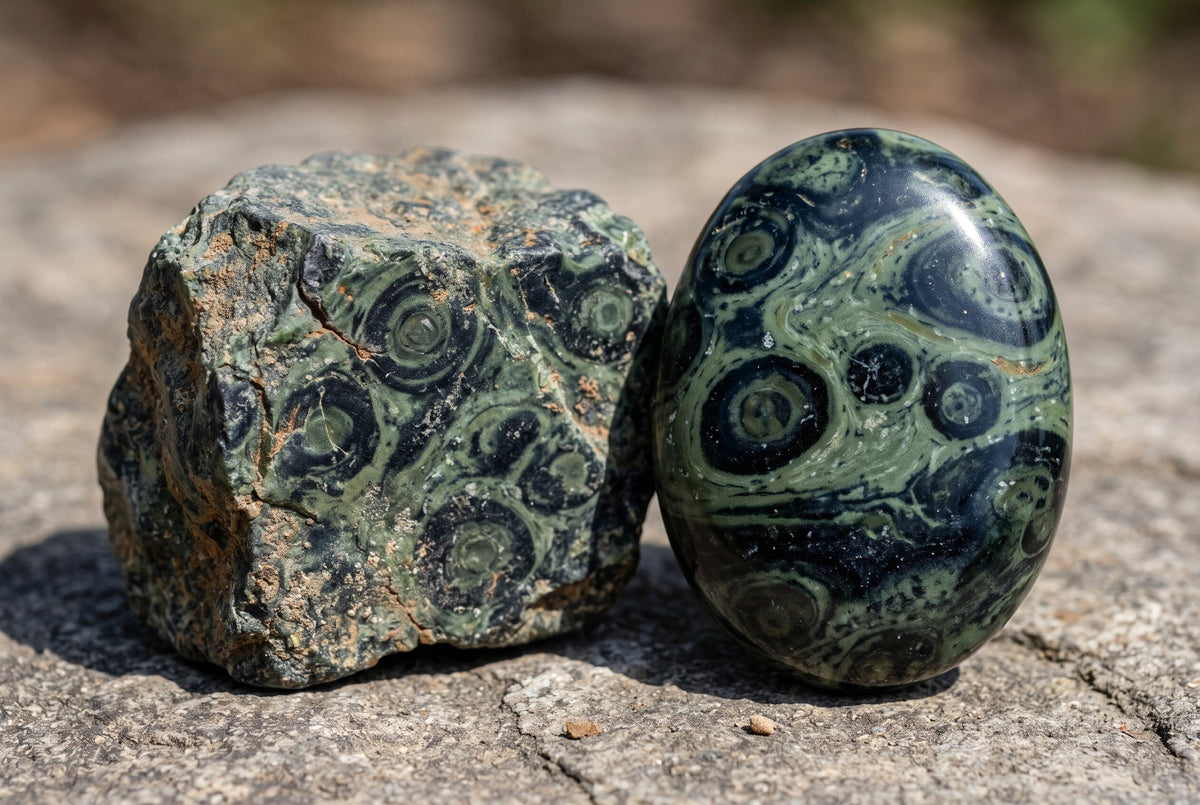
Picture a dark forest-green stone dotted with black circles that look like crocodile scales, moss clumps, or cells under a microscope. The orbs usually have a slightly lighter green rim, and the groundmass may show fine streaks or a faint mottling. On beads and spheres the orbs appear as bold black dots; on large cabochons and slabs you can see the swirled, almost organic layout that gives the stone its "ancient" look. Polished surfaces are glossy; rough pieces are dull and dark.

Where Does Kambaba Jasper Come From?
Kambaba jasper comes from Madagascar. The documented source is the Bongolava region of west-central Madagascar, roughly 125 miles (200 km) west of the capital, Antananarivo, where the stone is extracted from surface workings and shallow trenches and then cut locally or exported as rough to cutting centers in India and China. Some articles also list South Africa as a source, but no specific South African locality has been documented, so treat that as unverified.
Madagascar is also the home of ocean jasper (a spherulitic chalcedony from the northwest coast), and the similar-sounding local names are one reason kambaba's geology has been confused in print. The two stones look different: ocean jasper is multicolored with small, tightly packed orbs; kambaba is green with large black orbs.

Kambaba Jasper Meaning
In crystal lore, kambaba jasper is a stone of peace, grounding, and quiet endurance. Its deep green color and ancient-looking pattern have given it a traditional meaning of connection to nature, patience, and steady growth, the idea that strength can be calm rather than forceful. Many practitioners describe it as a "stone of tranquility" and reach for it when they want a sense of stability and a slower pace.
The stone's supposed age also shapes its symbolism: whether or not a particular piece is a fossil, kambaba is widely treated as a reminder of deep time, resilience, and the long view. These are cultural and spiritual associations rather than proven effects.
Kambaba Jasper Metaphysical Properties
Within crystal tradition, kambaba jasper is associated with:
- Grounding and emotional steadiness
- Calm, patience, and release of worry (as a worry stone to hold)
- Protection and a sense of safety, especially in new or unfamiliar surroundings
- Connection to nature, growth, and renewal
- Steady focus during meditation
These are traditional beliefs, not medical claims.
Kambaba Jasper and the Chakras
Practitioners link kambaba jasper primarily to the heart chakra (its green color; compassion and emotional balance) and to the root chakra (its dark, earthy pattern; grounding and security). It is often used as a bridge stone between the two in chakra layouts. Traditional belief, not a medical claim.

Kambaba Jasper Healing Properties: What Crystal Lore Says
In crystal-healing tradition, kambaba jasper is described as a soothing, grounding stone, carried or worn for a sense of calm and kept at the bedside or on a desk as a quiet anchor. Any feeling of ease that comes from a mindful routine is a personal experience, not a property of the stone. Crystals cannot diagnose, treat, cure, or prevent any illness and are not a substitute for professional medical or mental-health care.
These descriptions reflect spiritual traditions and personal practices, not proven physical or psychological effects, and are not medical claims.
How People Use Kambaba Jasper
- Worn as jewelry: beaded bracelets and strands, pendants, and cabochon rings are the most common forms, and the stone is durable enough for daily wear.
- As a worry stone or palm stone: the smooth, cool surface and bold pattern make it a favorite for tumbled stones.
- In meditation and crystal grids: traditionally placed at the heart or root positions, or paired with clear quartz and black tourmaline.
- As decor: spheres, slabs, and freeforms show the orbicular pattern best.
Kambaba Jasper vs. Nebula Stone, Rhyolite, and Other Look-Alikes
Several green-and-black stones are confused with kambaba jasper, and one of them, nebula stone, is regularly mislabeled on purpose because it sells for more. The quickest check is which color is the background and which is the spot.
| Stone | Look | What it is | Origin | How to tell it from kambaba |
|---|---|---|---|---|
| Kambaba jasper | Green background, black orbs | Orbicular volcanic rock (quartz, feldspar, aegirine) | Madagascar | — |
| Nebula stone (Eldarite) | Black background, small green orbs | Similar volcanic rock (aegirine, feldspar, amphibole, quartz) | Mexico; trademarked name, undisclosed locality | Colors reversed; much higher price; often mislabeled kambaba |
| Rainforest jasper (rhyolite) | Mossy green, cream, tan with cavities and orbs | Spherulitic rhyolite | Australia (Mt. Hay) | Lighter, more multicolored; often has tiny vugs |
| Ocean jasper | Multicolor (green, white, pink, yellow), small tight orbs | Spherulitic chalcedony | Madagascar | Many colors; translucent chalcedony edges |
| Malachite | Banded light and dark green, concentric rings | Copper carbonate mineral | DR Congo and others | Bright green bands, not black orbs; soft (3.5–4); heavy |
| Moss agate / tree agate | Green inclusions in translucent or white chalcedony | Chalcedony with inclusions | India, USA | Translucent areas; no circular orbs |
| Dyed "green jasper" or glass | Flat, uniform green with printed-looking spots | Dyed stone or man-made | Various | Too uniform; color concentrates in cracks; glass may show bubbles |
If a listing says "nebula stone" but the photo shows a green stone with black spots, it is kambaba jasper. If it says "kambaba" and shows a black stone with green spots, it may be nebula stone, but ask for the source: genuine nebula stone comes only through its trademark holder's supply chain.

Kambaba Jasper in Jewelry: Beads, Cabochons, and Durability
Kambaba jasper is one of the easiest patterned stones to work with. With a hardness around 6–7, no cleavage, and an opaque body, it survives drilling, tumbling, and daily wear far better than softer decorative stones such as malachite or apophyllite. What jewelry makers use:
- Round beads (4–12 mm) for bracelets and strands; 8 mm is the North American bracelet standard
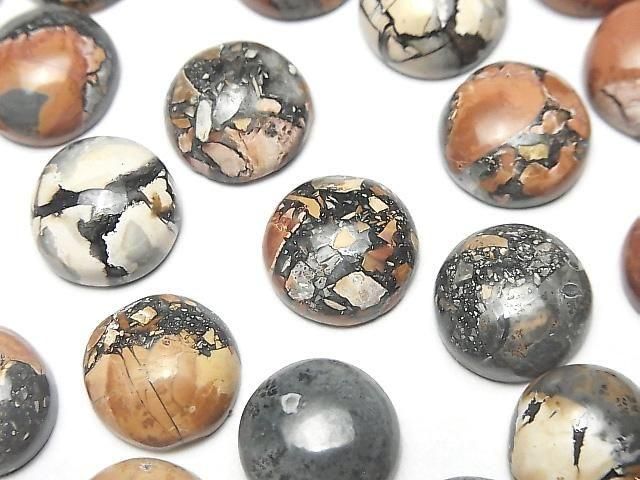
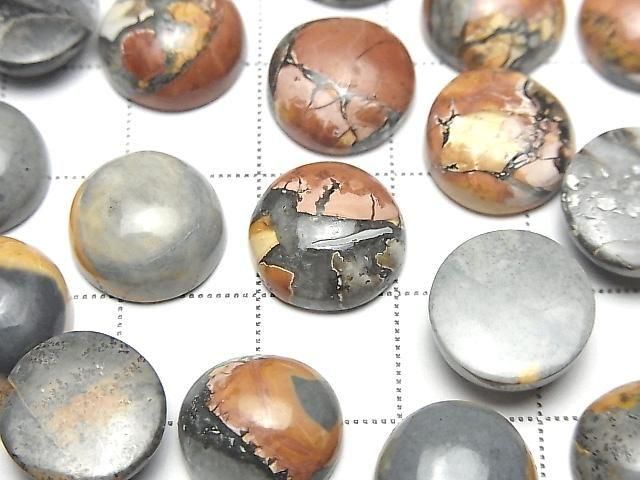
- Cabochons (ovals, rounds, freeforms) for bezel-set pendants and rings; large orbs look best on 25 mm and larger cabs
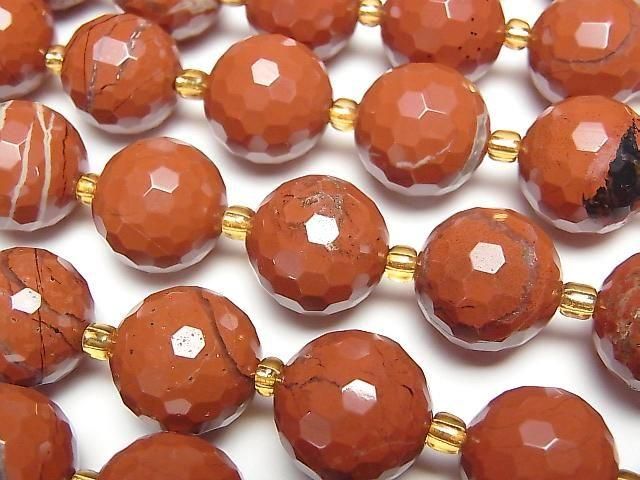
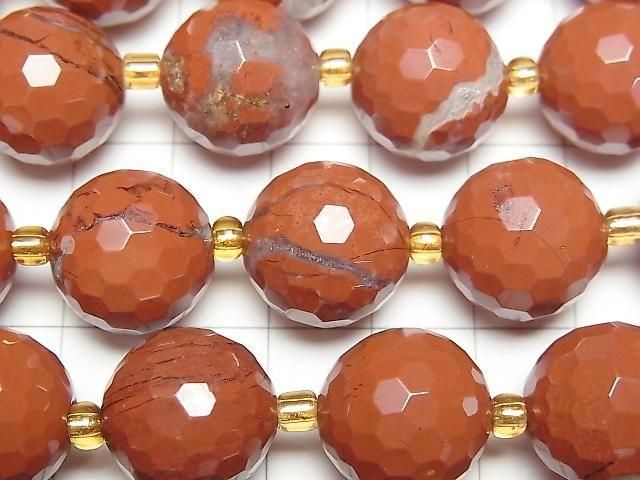
- Faceted or cube-cut beads for a modern look; the pattern reads as black dots on dark green
- Tumbled stones, palm stones, and spheres for gift and decor lines
Design notes: the stone's dark green pairs naturally with sterling silver, gunmetal, and copper, and with contrasting beads such as white howlite, black onyx, or unakite. Because every bead shows a different orb pattern, buy full strands rather than mixed lots if you want matched bracelets. Kambaba beads are generally undyed, which is a selling point to mention in your listings.

How to Tell If Kambaba Jasper Is Real
- Pattern: natural kambaba shows orbs of different sizes with soft, slightly irregular edges and lighter rims; printed or dyed imitations repeat the same spot shapes.
- Color depth: the green should vary from orb to orb and across the groundmass; a flat, uniform green is a warning sign.
- Hardness: it should scratch glass and resist a steel blade. Dyed howlite or magnesite is much softer.
- Weight and feel: it is dense and cool to the touch; plastic and resin feel light and warm quickly.
- Dye check: wipe with a cotton swab dampened with acetone-free nail-polish remover on an unseen spot; genuine kambaba leaves no color.
- Price and name: very cheap "nebula stone" is kambaba; very bright "kambaba" may be dyed jasper. Buy from suppliers who state origin and treatment.
How to Clean and Care for Kambaba Jasper
Kambaba jasper is low-maintenance. It can get wet, it does not fade in normal light, and it is not affected by salt or mild soap.

- Clean with warm water, a drop of mild dish soap, and a soft cloth or brush; rinse and dry.
- Ultrasonic cleaners are usually safe for solid beads and cabochons; skip them for pieces with visible fractures or glued settings.
- Avoid harsh chemicals and abrasive cleaners that could dull the polish.
- Store beads and cabochons separately from harder stones (sapphire, topaz, diamond) to avoid scratches.
- Energetic "cleansing" by running water, sunlight, or a bowl of salt will not harm the stone; just rinse salt off afterward.
Frequently Asked Questions About Kambaba Jasper
What is kambaba jasper good for?
Practically, it is a durable, affordable green stone for beads, cabochons, and tumbled stones. In crystal lore it is traditionally associated with calm, grounding, and steady strength. These are cultural beliefs, not medical claims.
What is the meaning of kambaba jasper?
In crystal tradition, kambaba jasper symbolizes peace, patience, grounding, and connection to nature, and is sometimes called the stone of tranquility. It is linked to the heart and root chakras. Traditional belief, not a medical claim.
Is kambaba jasper a real jasper?
No. Laboratory analysis shows it is a green orbicular volcanic rock made of quartz, feldspar, and aegirine, not a chalcedony jasper. "Jasper" is a trade name based on its appearance.
Is kambaba jasper a fossil or a stromatolite?
Many sellers say so, but analyzed commercial material shows a volcanic, not sedimentary, origin, and geologists believe two different Madagascar stones have been confused. Treat the fossil claim as unverified unless documented for a specific lot.
Where is kambaba jasper from?
Madagascar. The documented locality is the Bongolava region of west-central Madagascar. South Africa is sometimes listed as a source, but no specific locality there has been documented.
What is the difference between kambaba jasper and nebula stone?
Kambaba jasper is green with black orbs; nebula stone is black with small green orbs and comes from Mexico under a trademarked name. They are similar rocks, but nebula stone is rarer and more expensive, so kambaba is often mislabeled as nebula stone.
How hard is kambaba jasper?
About 6 to 7 on the Mohs scale, depending on how much quartz versus feldspar and aegirine a given piece contains. That is hard enough for rings, bracelets, and everyday jewelry.
Can kambaba jasper get wet?
Yes. It is an opaque, stable rock that can be washed with water and mild soap, and it is not damaged by salt, sunlight, or normal humidity.
What chakra is kambaba jasper associated with?
In crystal tradition, the heart chakra (green color) and the root chakra (dark, earthy pattern). Traditional belief, not a medical claim.
Is kambaba jasper dyed?
Usually not; the green and black are natural. A flat, uniform green or color that collects in cracks suggests a dyed imitation. Buy from suppliers who state origin and any treatment.
Shop Kambaba Jasper and Other Jasper Beads at KenKenGems
KenKenGems is a wholesale gemstone-bead and jewelry-supply store serving makers across the United States and Canada. Browse our jasper collection for kambaba jasper and hundreds of other patterned jaspers in round beads, faceted beads, cabochons, and bracelets, plus impression jasper and agate for coordinating strands. Every listing states the stone's name, origin, and any treatment, prices are in USD (CAD for Canadian customers), and orders over US$300 ship free. For more stone guides, see our gemstone column.

Jasper collection from Kenkengems
Sources and Further Reading
- U.S. Federal Trade Commission, Guides for the Jewelry, Precious Metals, and Pewter Industries (16 CFR Part 23) (treatment disclosure and misuse of gemstone names)