- 1. Sugilite: The Complete Guide to This Rare Purple Crystal
- 2. What Is Sugilite? An Introduction to the Purple Gemstone
- 3. The History and Discovery of Sugilite
- 4. Sugilite Meaning and Symbolism
- 5. Physical and Chemical Properties of Sugilite
- 5-1. Hardness, Cleavage, and Durability
- 5-2. Color, Luster, and Pleochroism
- 6. Types of Sugilite Stone
- 6-1. Purple Sugilite
- 6-2. Plum Sugilite
- 6-3. Lilac Sugilite
- 6-4. Blue Sugilite
- 6-5. Webbed Sugilite
- 6-6. Leopard Skin Sugilite
- 6-7. Chalcedony Sugilite
- 6-8. Sugilite Jade
- 7. Where Is Sugilite Found? Mines and Deposits
- 8. How Much Is Sugilite Worth? Value and Price Guide
- 9. Sugilite Healing Properties and Benefits
- 9-1. Physical Healing Benefits
- 9-2. Emotional and Mental Healing
- 9-3. How to Use Sugilite for Healing
- 10. Metaphysical Properties of Sugilite
- 10-1. Chakra Associations
- 10-2. Spiritual Protection and Psychic Powers
- 11. Sugilite vs Amethyst: How to Tell the Difference
- 12. How to Identify Real Sugilite
- 13. How to Care for Sugilite Jewelry
- 14. Frequently Asked Questions About Sugilite
- 15. Shop Authentic Sugilite at KenKenGems
Sugilite: The Complete Guide to This Rare Purple Crystal
Sugilite is one of the rarest and most sought-after purple crystals on the planet. Prized for its vivid royal-purple color and powerful metaphysical energy, this gemstone has become a favorite among crystal collectors, jewelry designers, and spiritual practitioners alike.
In this complete guide, you'll learn everything about sugilite — from its meaning and healing properties to how it compares with amethyst, where it's mined, and how to tell a genuine stone from an imitation.
Use the table of contents below to jump to any section.

What Is Sugilite? An Introduction to the Purple Gemstone
Sugilite (pronounced ""SOO-gi-lite"") is a rare cyclosilicate mineral best known for its deep purple to lilac color.
First discovered in 1944 on a small Japanese islet, it remained obscure until a major deposit was unearthed in South Africa in 1975, propelling it into the world of fine jewelry and crystal healing.
Today, sugilite is considered one of the most powerful purple gemstones available, often compared to amethyst and charoite but distinct in both chemistry and energy.
Because high-quality gem-grade material is so limited, sugilite has earned a reputation as a collector's stone — and prices to match.

The History and Discovery of Sugilite
Sugilite was discovered in 1944 by Japanese petrologist Ken-ichi Sugi while studying the geology of Iwagi Islet in southern Japan. The initial specimens were heavily included and unremarkable in appearance, so the mineral attracted little attention beyond academic circles. The stone was officially named "sugilite" in his honor.
Everything changed in 1975, when miners working the Wessels Mine in South Africa's Northern Cape unearthed a massive deposit of gem-quality sugilite.
The South African material displayed colors ranging from soft lilac to electric royal purple — and this is the source of nearly all the fine sugilite on the market today.
The South African variety is sometimes traded under the names "wesselite," "lavulite," or "royal azel."

Sugilite Meaning and Symbolism
In crystal healing tradition, sugilite is known as the "love stone for this age." It is believed to embody pure spiritual love and to anchor that energy into the physical world. Its purple color connects it to the crown and third-eye chakras, making it a symbol of:
• Spiritual protection from negative energies
• Unconditional love and compassion
• Inner harmony and emotional balance
• Heightened intuition and psychic awareness
Because of its rarity, sugilite is also seen as a symbol of finding something precious and one-of-a-kind — a meaningful reminder for anyone going through a transformative life chapter.

Physical and Chemical Properties of Sugilite
Sugilite is a complex potassium-sodium lithium iron-manganese-aluminum cyclosilicate. Its chemistry is what gives it both its color range and its distinctive energy profile.
[Table]
Property | Value
Mineral Class | Cyclosilicate
Chemical Formula | KNa2(Fe,Mn,Al)2Li3Si12O30
Hardness (Mohs) | 5.5 – 6.5
Crystal System | Hexagonal
Color | Pale lilac to deep royal purple; rare blue varieties
Luster | Vitreous to waxy when polished
Transparency | Opaque to translucent
Pleochroism | Distinct (color shifts with viewing angle)
Hardness, Cleavage, and Durability
With a Mohs hardness of 5.5–6.5, sugilite is softer than quartz (7) and more fragile than many other purple gemstones.
It also has imperfect cleavage, which means it can chip if struck against a hard surface.
If you wear sugilite jewelry, treat it as a protected piece — remove it before manual work, exercise, or swimming.
Color, Luster, and Pleochroism
Sugilite's color comes from trace amounts of manganese and iron.
The most valuable specimens display a rich, even royal purple, but the stone is rarely uniform — most pieces show veining, swirls, or color zoning that make each one unique.
The pleochroic effect causes the stone's hue to shift subtly depending on the viewing angle, adding to its visual depth.

Types of Sugilite Stone
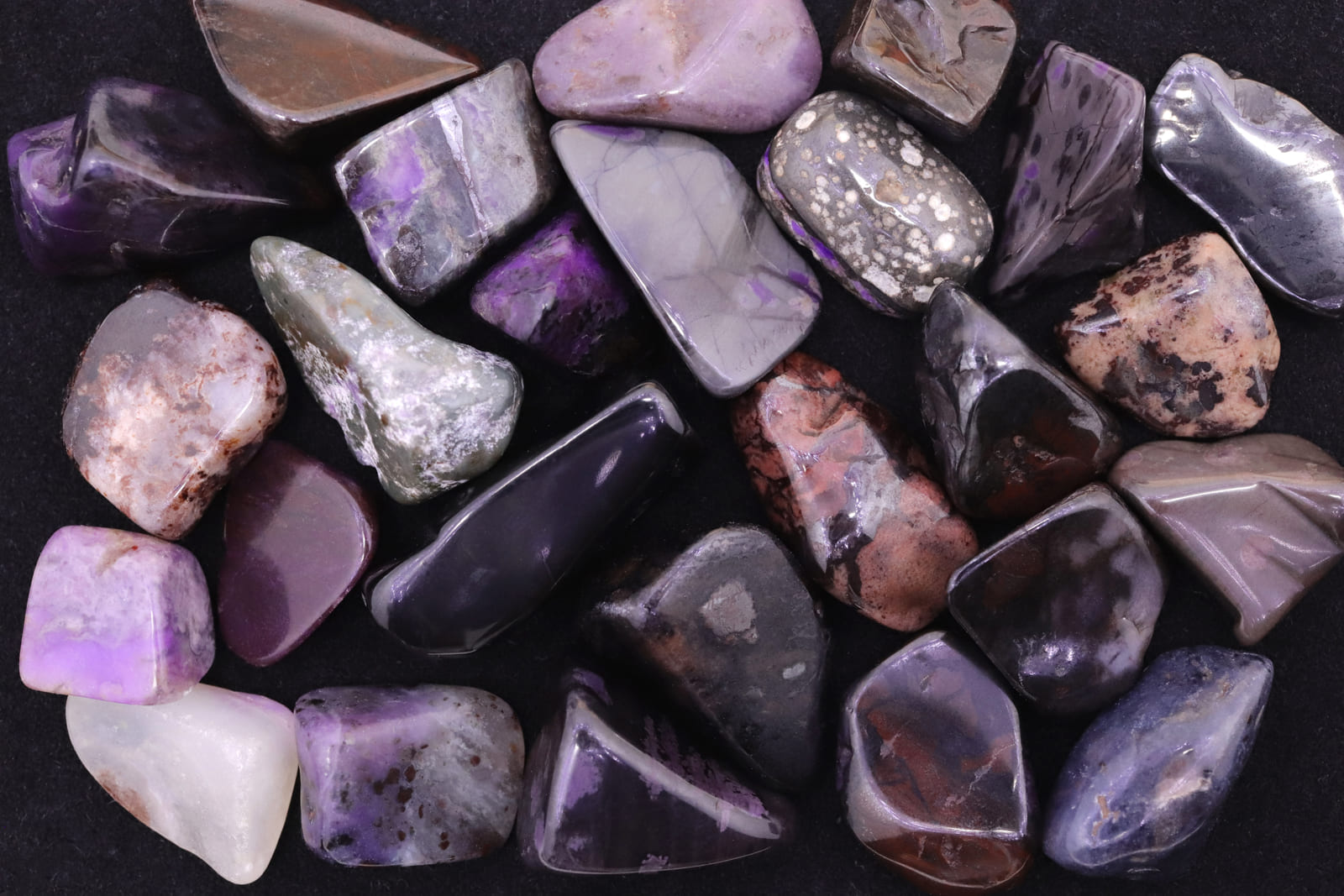
Although all sugilite shares the same core chemistry, gemologists and collectors recognize several visual varieties:
Purple Sugilite
The classic variety, prized for its vivid amethyst-like color blended with pale, almost white patches. The most widely traded type.
Plum Sugilite
Also known as "plum rustica." Extremely rare, with a saturated deep-purple body and bold, swirly black patterns.
Lilac Sugilite
A softer, lighter purple with dynamic gray, pink, and black inclusions. A favorite for delicate jewelry.
Blue Sugilite
A remarkable variety where royal blue dominates, accented by pink, purple, and gray swirls. One of the rarest forms.
Webbed Sugilite
Displays an intricate web of mineral veining — black, white, gray, pink, and yellow lines across a purple base.
Leopard Skin Sugilite
A spotted variety with contrasting white, black, brown, gray, and pink patches — instantly recognizable.
Chalcedony Sugilite
A natural amalgamation of sugilite and chalcedony, producing reddish-purple stones set against a dark matrix.
Sugilite Jade
A composite of sugilite mixed with quartz, feldspar, limonite, and chlorite. Often used in larger carvings.

Where Is Sugilite Found? Mines and Deposits
For decades, the Wessels Mine in South Africa was the only commercially significant source of gem-quality sugilite, and most fine material on the market still traces back to that single deposit.
Extensive mining has now significantly depleted the original reserves.
Smaller deposits have been documented in:
• Japan (the original 1944 discovery site)
• Canada (Mont Saint-Hilaire, Quebec)
• India
• Australia
• Tajikistan
• Italy
However, none of these other localities have produced commercial volumes comparable to South Africa. In total, only a few tons of sugilite have ever been mined since its discovery — making it genuinely one of the rarest gemstones in the world.

How Much Is Sugilite Worth? Value and Price Guide
Sugilite prices vary dramatically based on color, transparency, pattern, and origin. As a general guide:
• Tumbled stones / low-grade beads: $5 – $20 per piece
• Mid-grade cabochons: $30 – $150 per carat
• Gem-grade royal purple (translucent): $200 – $500+ per carat
• Investment-grade specimens: can exceed $1,000 per carat
The single biggest price driver is color saturation. A vivid, evenly colored royal-purple stone with translucency will command many multiples of an opaque, mottled piece of the same size.

Sugilite Healing Properties and Benefits
In crystal healing tradition, sugilite is regarded as a master healer for both body and spirit. Its high-vibration purple energy is said to address physical, emotional, and spiritual imbalances simultaneously.
Physical Healing Benefits
Crystal practitioners traditionally associate sugilite with:
• Relieving headaches and migraines
• Supporting cardiovascular health
• Strengthening immune-system function
• Easing eye strain and supporting vision health
Note: These are traditional spiritual associations, not medical claims. Always consult a healthcare professional for any physical condition.
Emotional and Mental Healing
Sugilite is especially treasured for its emotional benefits. Practitioners use it to:
• Dissolve anger, fear, and emotional trauma
• Ease anxiety and depressive states
• Encourage self-forgiveness and self-love
• Promote restful, peaceful sleep
How to Use Sugilite for Healing
There are several traditional ways to work with sugilite:
• Wear it as jewelry close to the heart or third-eye area
• Place a stone on the solar plexus during meditation
• Hold a tumbled stone in the palm during stressful moments
• Keep a piece by your bedside for restorative sleep

Metaphysical Properties of Sugilite
Purple stones are highly prized by sorcerers and mediums, and sugilite is no exception. It is believed that the mineral increases psychic and clairvoyance capabilities, as well as the ability to immerse oneself in a proper state for astral projection.
Psychics recommend sugilite talismans if the harmony between your mental and physical wellbeing is disrupted. Aside from that, they are able to protect against hostile energies, ill-wishers, and malevolent gazes. You can rely on the mineral to improve your stress resistance, provide tranquility, and dispel bad thoughts.
Color therapy insists that violet-lilac colors have a positive effect on the areas of the brain responsible for creativity. So, if you have something to do with art, studying, or development, sugilite of this color is a must.
Chakra Associations
Sugilite primarily resonates with the third-eye chakra and the crown chakra, making it a powerful stone for spiritual awakening, intuition, and connection to higher guidance. Lighter pink-purple varieties are also said to activate the heart chakra, linking divine love with earthly compassion.
Spiritual Protection and Psychic Powers
Sugilite is widely used as a protective talisman. Practitioners believe it:
• Shields the wearer from negative energies and psychic attacks
• Heightens clairvoyance and intuitive abilities
• Supports astral projection and lucid dreaming
• Encourages creative breakthroughs (especially for artists, writers, and students)

Sugilite vs Amethyst: How to Tell the Difference
Because both stones are purple and used in spiritual practice, sugilite and amethyst are often confused. They are, however, completely different minerals with very different properties.
[Comparison Table]
Property | Sugilite | Amethyst
Mineral Family | Cyclosilicate | Quartz (silicon dioxide)
Hardness | 5.5 – 6.5 | 7
Transparency | Opaque to translucent | Transparent to translucent Typical Color | Royal purple with veining and patterning | Even violet to light purple
Rarity | Extremely rare | Abundant
Price | $30 – $1,000+ per carat | $2 – $30 per carat
Chakra | Third-eye, crown (and sometimes heart) | Third-eye, crown
Quick visual test: if the purple stone is opaque, shows white or pink veining, and feels slightly softer when scratched with a steel knife (do not test on jewelry), it is most likely sugilite. A fully transparent, evenly colored crystal is almost certainly amethyst.

How to Identify Real Sugilite
Because sugilite is rare and expensive, imitations (often dyed howlite, magnesite, or plastic) are common in online marketplaces. Use these checks before buying:
• Color depth: real sugilite shows nuanced shifts from light to dark purple, not a flat printed-looking color.
• Patterns: natural sugilite almost always has veining, swirls, or color zoning. A perfectly uniform purple stone is suspicious.
• Hardness: it should scratch glass (Mohs 5.5+) but be scratched by quartz (Mohs 7).
• Weight: sugilite has a specific gravity of about 2.74, slightly heavier than dyed magnesite.
• Source: buy from established gemstone retailers who can verify origin and source documentation.

How to Care for Sugilite Jewelry
To preserve the color and integrity of your sugilite piece:
• Clean only with lukewarm water and a soft cloth — avoid ultrasonic and steam cleaners.
• Keep away from harsh chemicals, perfumes, and household cleaners.
• Store separately from harder stones (diamond, quartz, topaz) to prevent scratches.
• Limit prolonged exposure to direct sunlight, which can slowly fade the purple color.
• Cleanse energetically with moonlight or sound (avoid salt water and sun).

Frequently Asked Questions About Sugilite
•Is sugilite a rare stone?
Yes — sugilite is one of the rarest gemstones in the world. Since its discovery in 1944, only a few tons have ever been mined, with most gem-quality material coming from a single deposit at the Wessels Mine in South Africa, which is now largely depleted.
•What does sugilite do spiritually?
Spiritually, sugilite is known as the "love stone for this age." It is believed to open the third-eye and crown chakras, strengthen intuition, shield against negative energy, and anchor unconditional love into daily life.
•Who should wear sugilite?
Sugilite is especially recommended for empaths, highly sensitive people, healers, artists, and anyone going through grief or major life transition. It is also worn for protection against psychic stress and energetic burnout.
•Can sugilite get wet?
Brief contact with water is fine, but sugilite should not be soaked. Avoid salt water entirely, as it can damage the surface and dull the polish. Always dry the stone immediately after rinsing.
•Is sugilite worth buying?
If you're drawn to its energy or rarity, yes. Sugilite holds its value well due to limited supply, and high-grade specimens have historically appreciated. Beginners can start with a tumbled stone or small bead before investing in a fine cabochon.
•How can you tell if sugilite is fake?
Real sugilite shows natural color variation, veining, and a Mohs hardness of 5.5–6.5. Fakes are often dyed howlite or magnesite, which scratch easily and show uniform, flat color. Buy from reputable sellers who guarantee origin.

Shop Authentic Sugilite at KenKenGems
Looking to add this rare purple crystal to your collection? KenKenGems sources sugilite directly from the world's leading mines, including the legendary Wessels deposit.
Our collection includes:
• Royal-purple cabochon beads (gem-grade)
• Affordable polished strands for jewelry making
• One-of-a-kind specimens for collectors
Every piece is hand-selected for color, pattern, and quality — and shipped worldwide with free delivery on orders over USD $300.