
TOC
- 1. April Birthstone: The Diamond
- 2. What Is a Diamond?
- 3. The 4Cs: Diamond Quality and Value
- 3-1. Carat (Weight)
- 3-2. Cut
- 3-3. Color
- 3-4. Clarity
- 4. Natural vs Lab-Grown vs Simulants, and Treatments
- 5. Diamond Meaning and Symbolism
- 6. How to Care for and Buy a Diamond
- 7. April Birthstone (Diamond) FAQ
- 7-1. What is the birthstone for April?
- 7-2. Which zodiac signs go with the April birthstone?
- 7-3. What are the 4Cs of a diamond?
- 7-4. Are lab-grown diamonds real diamonds?
- 7-5. How can you tell a diamond from a simulant?
- 7-6. How much is a diamond worth?
- 7-7. How do I care for a diamond?
- 8. Shop April Birthstone Diamonds at KenKenGems
products available in this collection.
Shop NowApril Birthstone: The Diamond
The diamond is the birthstone for April, the month that covers two of the zodiac's most determined signs, Aries (about March 21 to April 19) and Taurus (about April 20 to May 20). Fittingly, the diamond is the hardest natural material known, and in folklore it has long been worn as a talisman of strength, love, and constancy.
This guide covers what a diamond actually is, its history and traditional meaning, how the 4Cs define quality and value, the difference between natural, laboratory-grown, and simulant stones, common treatments to look for, and how to care for and buy a diamond with confidence.
What Is a Diamond?
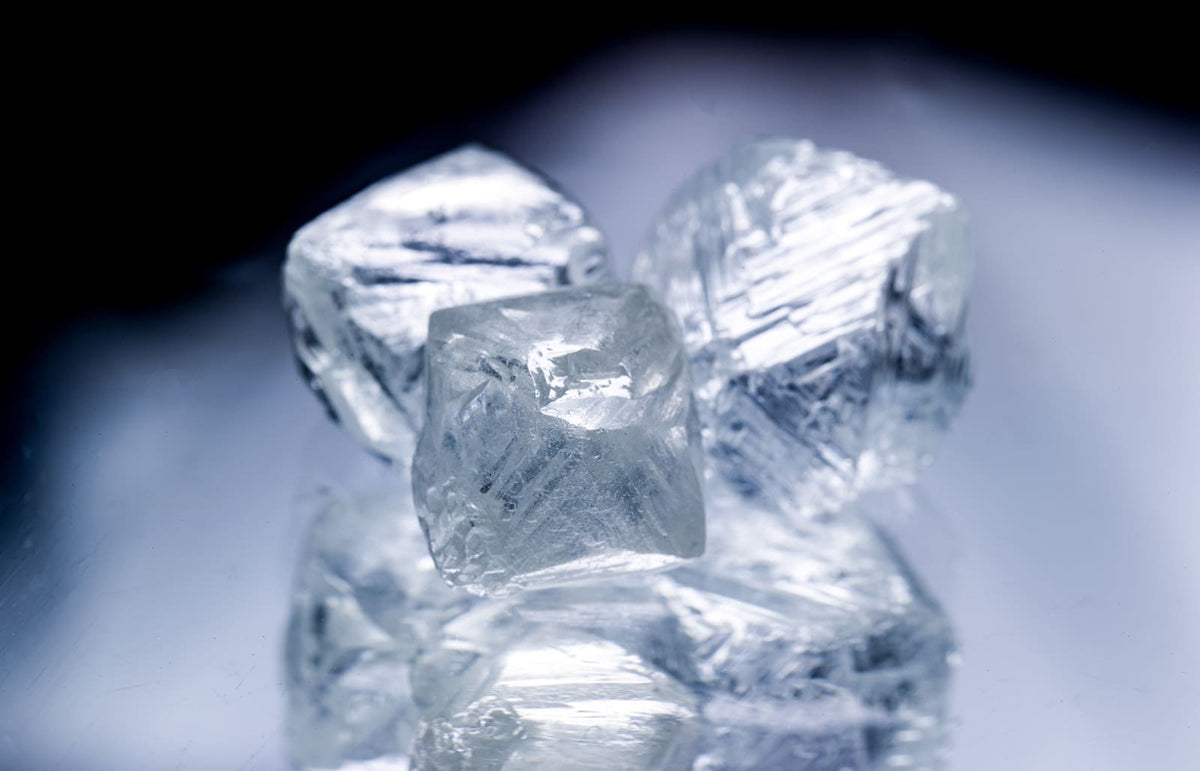
A diamond is a gem made of pure carbon, crystallized deep within the Earth under enormous heat and pressure. It is the same element as graphite and coal, arranged in a rigid crystal lattice that gives the diamond its hardness (a 10 on the Mohs scale, the highest of any natural mineral) and its bright fire and brilliance when cut. Natural diamonds are ancient, with many formed between about 1 and 3.3 billion years ago.
Diamonds were once gathered from riverbed deposits known as alluvial placers. Today most are mined from kimberlite pipes, the cooled channels where deep magma rose toward the surface; the first such pipe was identified in the Kimberley region of South Africa, which is where the rock takes its name. A large share of mined diamonds are of industrial grade and used in cutting and drilling tools, while gem-quality material is sorted, cut, and graded for jewelry.
In tradition, the diamond has been surrounded by story for around three thousand years. Ancient Indian texts described it as a bridge to the spirit world, and Greek and Roman writers linked it to the tears of the gods and the tips of Cupid's arrows. For much of history rough diamonds were overlooked because uncut stones look plain; only after cutting techniques developed, roughly five centuries ago, did their beauty become widely prized. These are historical beliefs and stories, shared here as folklore rather than fact.

The 4Cs: Diamond Quality and Value
A diamond's quality and value are described by the 4Cs: Carat, Cut, Color, and Clarity. The system was developed by the Gemological Institute of America (GIA), and independent reports from respected laboratories such as the GIA, IGI, or HRD are the most reliable way to confirm a stone's grades. Prices vary widely with the 4Cs and with market conditions, so treat any figures as general guidance rather than a fixed quote. To see how we grade and describe our own material, read our quality rank guide.

Carat (Weight)
Carat is the unit of weight for gemstones: one carat equals 0.2 grams (200 milligrams). The word comes from the carob seeds once used to balance scales. Larger diamonds are rarer, so price per carat tends to rise sharply at popular size thresholds, and a heavier stone is worth much more than the sum of several smaller stones of the same total weight.
Cut
Cut refers to a diamond's proportions, symmetry, and polish, and it is often the biggest single factor in how much a stone sparkles. It is not the same as shape: the round brilliant, with its 58 facets, is the most popular, while shapes such as princess, oval, pear, marquise, emerald, and heart are also common. GIA grades the cut of standard round brilliant diamonds on a scale from Excellent to Poor. A well-cut stone returns more light, so cut quality can influence price noticeably.
Color
For white diamonds, color is graded on the GIA scale from D (completely colorless and most prized) down to Z (a noticeable light yellow or brown tint). Faint color comes from trace elements and structural effects: nitrogen can create yellow tones and boron can create blue, while natural radiation over time can produce green hues. Diamonds with a strong, attractive color are graded on a separate "fancy color" scale, where the color itself is the prized feature; fancy pink, blue, and red stones are especially rare.
Clarity
Clarity describes the number, size, and position of a diamond's natural inclusions and surface blemishes. GIA grades clarity from Flawless (FL) and Internally Flawless (IF), through Very Very Slightly Included (VVS1-VVS2), Very Slightly Included (VS1-VS2), and Slightly Included (SI1-SI2), down to Included (I1-I3). Most inclusions are hard to see without magnification. Because size and location matter, a larger but heavily included stone can be worth less than a smaller, cleaner one.
Natural vs Lab-Grown vs Simulants, and Treatments
Natural diamonds form in the Earth over hundreds of millions to billions of years. When the word "diamond" is used on its own, it means a natural, mined diamond.
Laboratory-grown diamonds (also called laboratory-created, lab-grown, or synthetic) are real diamonds with the same chemical, physical, and optical properties as mined stones; they are grown by HPHT or CVD processes rather than formed in the ground. Under the U.S. FTC Jewelry Guides they must be clearly disclosed as laboratory-grown or laboratory-created, and it is not accurate to call them "fake." They are typically less expensive than comparable natural diamonds. The honest distinction is natural diamond versus laboratory-grown diamond, not "real" versus "fake."
Simulants are not diamonds. Cubic zirconia and moissanite look similar but are entirely different materials with different chemistry, hardness, and optics, so they must never be described as diamonds. A thermal-and-electrical conductivity tester, or an independent laboratory report, can distinguish diamond from simulants.
Treatments should be disclosed. Some diamonds are treated to change their appearance, for example HPHT or irradiation to alter color, laser drilling to reach and lighten dark inclusions, and fracture (clarity) filling to make inclusions less visible. Each of these should be disclosed at the point of sale. At KenKenGems, stones are described accurately as natural, laboratory-grown, or treated so you always know what you are buying.

Diamond Meaning and Symbolism
In folklore and crystal lore, the diamond is a symbol of enduring love, strength, purity, and invincibility, which is why it became the classic engagement stone. It has traditionally been carried as a protective talisman and as a token of commitment and clarity.
- Love and commitment: traditionally believed to strengthen bonds and represent fidelity.
- Strength and courage: in old stories, warriors and travelers carried diamonds as talismans.
- Purity and clarity: long associated with honesty and a clear, steadfast mind.
- April birthstone: and the traditional gem for 60th and 75th wedding anniversaries.
Older legends went further, claiming a diamond could sharpen the senses, calm the mind, or influence health and childbearing. Such ideas are historical beliefs and stories, not facts. These are traditional beliefs, not medical claims. A diamond is not medicine and cannot diagnose, treat, cure, or prevent any illness; consult a qualified professional for any health concern.

How to Care for and Buy a Diamond
Diamonds are hard enough for everyday wear, but hardness is not the same as toughness: a sharp knock can chip a diamond along a cleavage plane, so a little care keeps a stone looking its best.
- Clean with warm water, a drop of mild dish soap, and a soft brush to restore sparkle.
- Avoid hard knocks against surfaces or other stones, since a diamond can chip or cleave.
- Store diamonds separately, because they can scratch other gems and even one another.
- Have prong settings checked periodically so a stone is not lost.
- Ultrasonic cleaning is usually fine for untreated diamonds, but avoid it for fracture-filled or heavily included stones.
When buying, decide which of the 4Cs matter most to you, ask for an independent grading report from a laboratory such as the GIA or IGI, and confirm in writing whether a stone is natural or laboratory-grown and whether it has been treated. A clear, honest disclosure is the sign of a trustworthy seller.
April Birthstone (Diamond) FAQ
What is the birthstone for April?
The birthstone for April is the diamond, a gem of pure carbon and the hardest natural material known. It is traditionally linked with love, strength, and constancy.
Which zodiac signs go with the April birthstone?
April covers Aries (about March 21 to April 19) and Taurus (about April 20 to May 20), so the diamond is the traditional stone for both April-born signs.
What are the 4Cs of a diamond?
Carat, Cut, Color, and Clarity. These GIA grading factors together describe a diamond's quality and help determine its value.
Are lab-grown diamonds real diamonds?
Yes. Laboratory-grown diamonds have the same chemical and physical properties as mined diamonds and are real diamonds; they differ in origin and price. Sellers must clearly disclose when a diamond is laboratory-grown, and simulants such as cubic zirconia and moissanite are not diamonds.
How can you tell a diamond from a simulant?
A thermal-and-electrical conductivity tester separates diamond from simulants like cubic zirconia and moissanite, and an independent laboratory report is the surest confirmation. Home tests are unreliable.
How much is a diamond worth?
It depends on the 4Cs and the market, ranging from modest prices for small commercial stones to very high prices for rare, high-grade, or fancy-colored gems. Treat any figure as general guidance.
How do I care for a diamond?
Clean it with warm water, mild dish soap, and a soft brush; avoid sharp knocks; and store it separately so it does not scratch or get scratched by other stones.
Shop April Birthstone Diamonds at KenKenGems
KenKenGems offers a wide selection of April birthstone diamonds, from off-white, light-brown, and black diamonds to faceted beads, strands, rose-cut stones, pendants, and charms in many shapes. Every stone is described honestly as natural, laboratory-grown, or treated, so you know exactly what you are choosing for jewelry making or collecting.
Browse the full diamond collection to find the right April birthstone for you, and see our quality rank guide to understand how each stone is graded and described.


