
TOC
- 1. What Are Freshwater Pearls?
- 2. Natural vs Cultured Freshwater Pearls
- 3. Freshwater Pearls Properties
- 3-1. Colors, Shapes, and Sizes
- 3-2. Are Freshwater Pearls Real?
- 4. Freshwater vs Saltwater Pearls
- 5. Where Do Freshwater Pearls Come From?
- 6. Freshwater Pearl Quality and Value
- 7. Freshwater Pearls Meaning and Symbolism
- 8. How to Care for Freshwater Pearls
- 9. Freshwater Pearls FAQ
- 9-1. Are freshwater pearls real?
- 9-2. Are freshwater pearls valuable?
- 9-3. What is the difference between freshwater and saltwater pearls?
- 9-4. Can freshwater pearls get wet?
- 9-5. How long do freshwater pearls last?
- 9-6. What is the difference between mother of pearl and freshwater pearls?
- 9-7. Can you wear freshwater pearls every day?
- 9-8. Are freshwater pearls dyed or treated?
- 10. Buying Freshwater Pearls from KenKenGems

What Are Freshwater Pearls?
Freshwater pearls are pearls that form inside freshwater mollusks (mussels) rather than saltwater oysters. Like all pearls, they are made of nacre — layers of calcium carbonate and a binding protein — built up by the mollusk around an irritant. A marvel of nature, they are among the very few gems produced by living creatures, and the fact that something so lustrous can grow from a tiny irritant is a large part of their appeal. Today the vast majority of freshwater pearls are cultured, which keeps them beautiful, sustainable, and affordable.
Natural vs Cultured Freshwater Pearls
The difference is how the pearl started, not whether it is "real." Natural pearls form by chance when an irritant enters a wild mollusk; they are extremely rare and can be very expensive, which is why they mostly appear at auction. Cultured pearls are started by people under controlled conditions — and they are still genuine pearls, made of the same nacre. Under the FTC Jewelry Guides, sellers should disclose that a pearl is cultured, and reputable listings always do.
For freshwater pearls, culturing usually means inserting a small piece of donor mantle tissue (rather than a bead) into a host mussel. Over roughly 3 to 8 years the mussel deposits nacre around it. Freshwater mussels can grow several pearls at once, in rivers, lakes, and even repurposed ponds. Farms carefully monitor water temperature, chemistry, and pH, and the final shape and color are largely left to nature. About 99% of the world’s pearl supply today is cultured, a practice that also helps preserve wild mollusk populations.

Freshwater Pearls Properties
Freshwater pearls are an organic gem made of nacre and a protein called conchiolin. Nacre is essentially calcium carbonate — the same material as mother of pearl — so a pearl is, in effect, an organic limestone compound. Because freshwater pearls are usually tissue-nucleated, they are almost solid nacre, which makes them more durable and abrasion-resistant than many bead-nucleated saltwater pearls. Even so, pearls are soft (about 2.5–4.5 on the Mohs scale), so they need gentle handling.
A quick note on treatments: many freshwater pearls, especially from China, are dyed, bleached, or irradiated to change or even out color, and some are coated with a thin lacquer to boost luster. These treatments should be disclosed, and dyed color can fade over time, so it is worth asking whether a pearl’s color is natural or treated before you buy.

Colors, Shapes, and Sizes
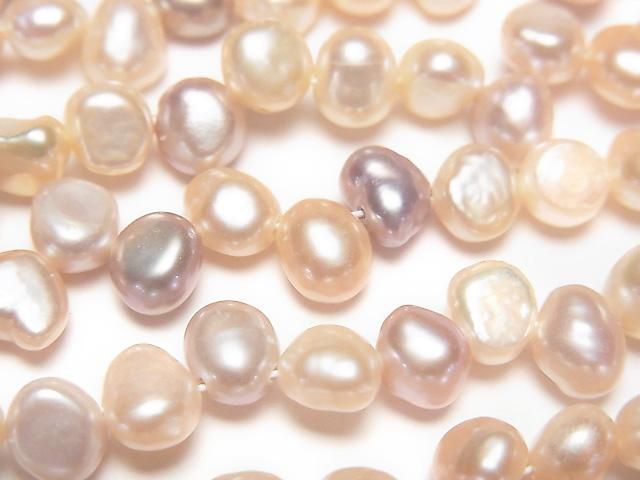
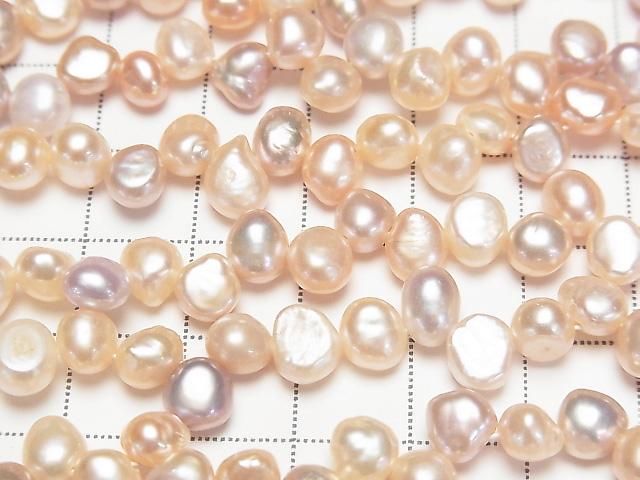
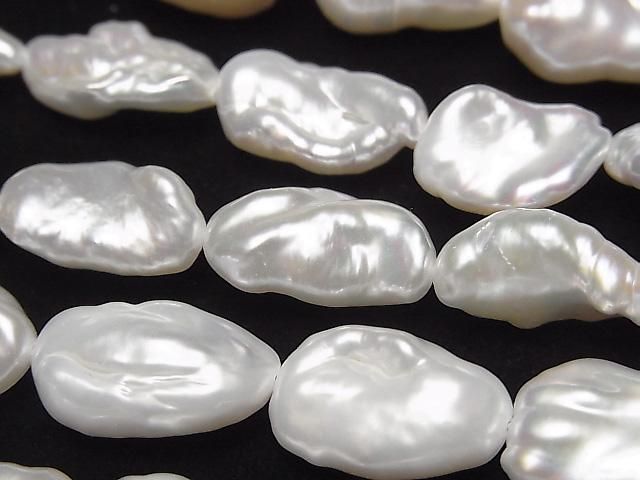
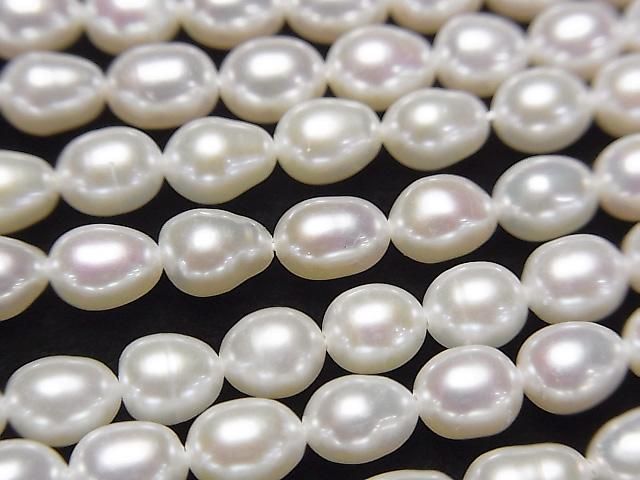
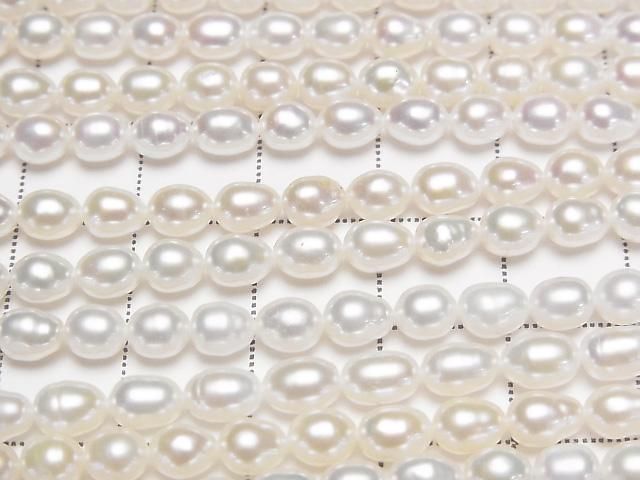
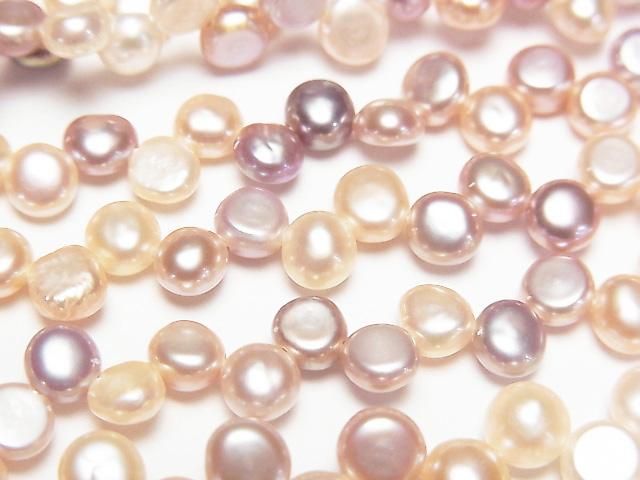
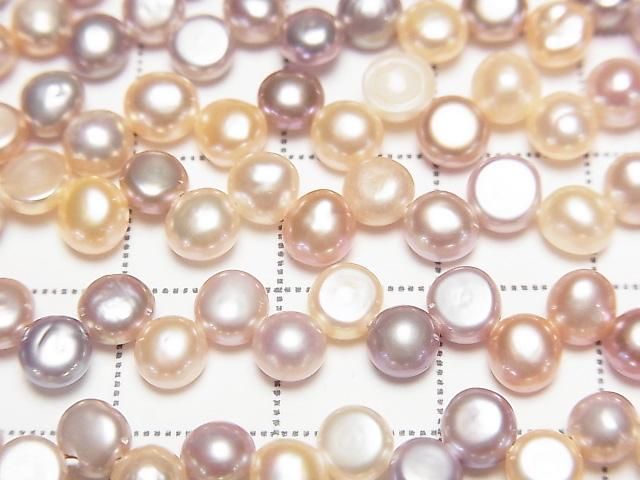
Freshwater pearls come in more shapes and colors than most gems. Shapes range from round and near-round to oval, drop, button, and baroque (irregular); perfectly round freshwater pearls are the rarest and most prized. Natural body colors include white, cream, champagne, pink, lavender, and gray, often with a soft, uneven blush that shifts between shades. Typical sizes run about 4–6 mm, with prized specimens exceeding 10 mm. Size takes time: a pearl needs roughly 1.5 years to reach 3 mm, another 1.5 years to reach 7 mm, and about 7 years to reach 10 mm.
Are Freshwater Pearls Real?
Yes — cultured freshwater pearls are real pearls. "Cultured" describes how the pearl was started (with human help), not an imitation. Real pearls, cultured or natural, are grown by a mollusk from genuine nacre. What is not a real pearl is a "shell pearl," "glass pearl," or plastic bead made to look like one; those are imitations and should be labeled as such. A simple at-home clue is the "tooth test": real nacre feels slightly gritty against the edge of your teeth, while imitation beads feel smooth — though the reliable check is buying from a seller who discloses whether pearls are cultured, natural, or imitation.
Freshwater vs Saltwater Pearls
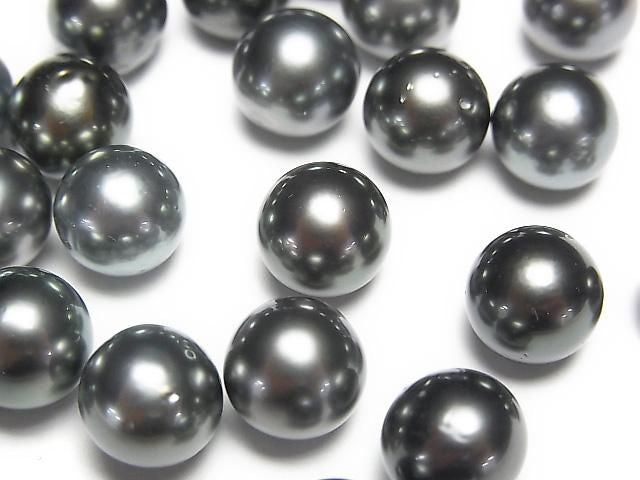
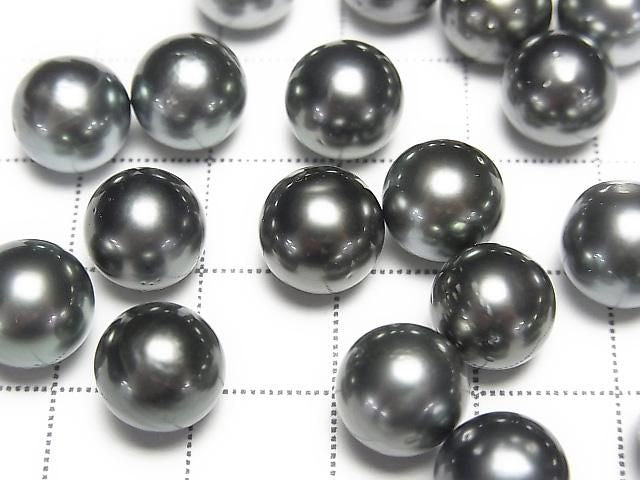
The main differences come down to how they are nucleated and where they grow. Freshwater pearls are usually tissue-nucleated and nearly solid nacre, which makes them durable and affordable; saltwater pearls (Akoya, Tahitian, South Sea) are usually bead-nucleated and often rounder with sharper luster, at higher prices.
| Feature | Freshwater | Saltwater (Akoya / Tahitian / South Sea) |
|---|---|---|
| Mollusk | Freshwater mussel | Saltwater oyster |
| Nucleation | Usually tissue (no bead) | Usually bead + tissue |
| Nacre | Thick, nearly solid | Thinner layer over a bead |
| Shape | More varied; round is rarer | Often rounder |
| Luster | Soft to bright | Often sharper, more reflective |
| Yield | Several pearls per mussel | Typically one per oyster |
| Price | More affordable | Generally higher |
Where Do Freshwater Pearls Come From?
China dominates freshwater pearl production, growing far more than the rest of the world combined, with much of the industry centered near Shanghai around Taihu Lake — the cradle of freshwater pearling, where cultured pearls first appeared roughly seven centuries ago. Japan is known for finer freshwater pearls: historic Lake Biwa pearls could reach 13–15 mm, larger than the usual 10 mm ceiling. Japan is also associated with Keshi pearls — small, irregular, non-nucleated pearls that occur as a byproduct of pearl culturing.

Freshwater Pearl Quality and Value
Freshwater pearl value is judged on a handful of factors rather than a single grade. In general, the higher and sharper the luster, the rounder the shape, the cleaner the surface, and the larger and better-matched the pearls, the more valuable the strand. Compared with saltwater pearls, freshwater pearls are famously affordable, which makes them ideal for everyday jewelry and beading.
- Luster: the most important factor — the depth and sharpness of the reflected light
- Shape: round is rarest and priciest; drops and baroques cost less and offer character
- Surface: fewer spots, bumps, and blemishes mean higher value
- Size: larger pearls take years longer to grow and cost more
- Color and matching: even, appealing color and well-matched strands add value
A note on grading: letter scales such as "A–AAA" are common in the trade but are not a single official standard, so what "AAA" means can vary by seller. Treat any grade as a starting point and judge luster and surface with your own eyes. Everyday freshwater strands are typically inexpensive in USD/CAD, while large, round, high-luster pearls command a premium.
Freshwater Pearls Meaning and Symbolism
Across many cultures, pearls have long symbolized purity, wisdom, and calm. It is important to be clear that these are cultural and historical beliefs, not medical facts: pearls are not a medicine and do not diagnose, treat, cure, or prevent any disease, and no gemstone should replace professional medical care.
With that context, here is how pearls appear in tradition and folklore:
- In India, pearls have been seen as a symbol of prosperity and stability
- In China, pearls are traditionally associated with clarity of thought and dignity
- In ancient Greece, pearls symbolized wisdom, love, and harmony, and were valued by married couples
- Historically, pearls have represented purity and are a traditional gift for weddings and 30th anniversaries
Pearl is also the birthstone for June. These are traditional beliefs and cultural associations, not medical claims — most people simply enjoy freshwater pearls as an elegant, meaningful gem.

How to Care for Freshwater Pearls
Treat freshwater pearls gently and keep them away from chemicals, and they can last for generations. Because pearls are soft and porous, the golden rule is "last on, first off" — put jewelry on after perfume, lotion, and hairspray, and take it off before cleaning or exercising.
- Chemicals: avoid perfume, cosmetics, hairspray, and household cleaners, which dull nacre
- Water: a brief splash is fine, but do not soak pearls or wear them swimming; dry them before storing
- Cleaning: wipe with a soft, slightly damp cloth after wearing; never use ultrasonic or steam cleaners
- Storage: keep them flat in a soft pouch, separate from harder gems, and away from very dry heat
- Restringing: have strung pearls restrung periodically if worn often, as thread can weaken over time
With this care, well-made freshwater pearls easily last for decades and are often passed down as heirlooms.
Freshwater Pearls FAQ
Quick answers to the questions people most often ask about freshwater pearls.
Are freshwater pearls real?
Yes. Cultured freshwater pearls are genuine pearls made of real nacre; "cultured" only means the process was started with human help. Glass, plastic, or "shell pearls" are imitations and should be labeled as such.
Are freshwater pearls valuable?
They are generally more affordable than saltwater pearls, but value rises with luster, roundness, clean surface, size, and good matching. Large, round, high-luster strands can be quite valuable.
What is the difference between freshwater and saltwater pearls?
Freshwater pearls grow in mussels and are usually tissue-nucleated and nearly solid nacre, making them durable and affordable. Saltwater pearls (Akoya, Tahitian, South Sea) grow in oysters, are usually bead-nucleated, and are often rounder with sharper luster at higher prices.
Can freshwater pearls get wet?
A brief splash is fine, but do not soak them or wear them swimming, and dry them before storing. Prolonged water and chemicals can weaken the nacre and the string.
How long do freshwater pearls last?
With gentle care — keeping them away from chemicals and restringing worn strands periodically — freshwater pearls can last for decades and are often passed down as heirlooms.
What is the difference between mother of pearl and freshwater pearls?
They are made of the same material (nacre). Mother of pearl is the iridescent lining of the shell, while a pearl is the rounded gem the mollusk forms; both are calcium carbonate nacre.
Can you wear freshwater pearls every day?
Yes, with care. Put them on last, take them off before washing or exercising, and wipe them after wear. Avoid ultrasonic cleaners and direct contact with chemicals.
Are freshwater pearls dyed or treated?
Many are dyed, bleached, irradiated, or lightly coated to change or enhance color and luster. Treatments should be disclosed, and dyed color can fade over time, so ask whether the color is natural.
Buying Freshwater Pearls from KenKenGems
When buying freshwater pearls for jewelry making, match the pearls to your project and check how color and treatment are described. KenKenGems supplies cultured freshwater pearls from China and Japan for every taste and budget — from inexpensive Keshi to round, high-luster strands — available in strands, half-strands, and 3, 5, and 10-piece sets.
We clearly describe whether pearls are natural-color or dyed so you know exactly what you are getting. When comparing options, look at luster and surface first, then shape, size, and matching, and keep bead size (mm) and strand length (inches) in mind for your design.


![Akoya-Perlen AAA Rund 7-7.5mm Metallisch Grün [Halboffene Bohrung] 2Stk](http://store.kenkengems.com/cdn/shop/files/192282996.jpg?v=1782842368&width=640)
![Akoya-Perlen AAA Rund 7-7.5mm Metallisch Grün [Halboffene Bohrung] 2Stk](http://store.kenkengems.com/cdn/shop/files/192282996_o1.jpg?v=1782842353&width=640)


![Süßwasserperle AAA Lose Stein Rund 8-9mm [Halboffene Bohrung] Weiß 1Stk](http://store.kenkengems.com/cdn/shop/files/192285392.jpg?v=1782842185&width=640)
![Süßwasserperle AAA Lose Stein Rund 8-9mm [Halboffene Bohrung] Weiß 1Stk](http://store.kenkengems.com/cdn/shop/files/192285392_o1.jpg?v=1782842172&width=640)